

What's Happening?
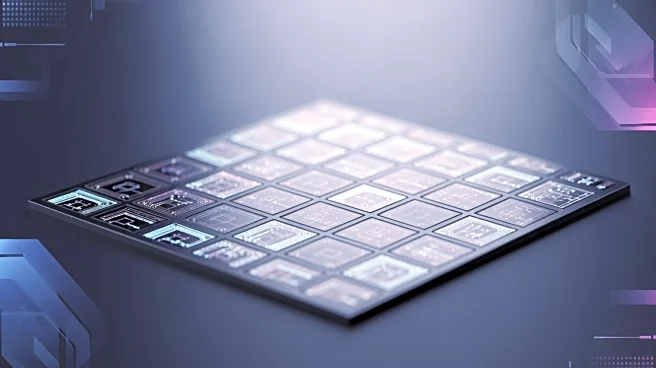
Recent research has made significant strides in the field of quantum computing, focusing on the integration and scalability of qubits. Researchers at Delft University of Technology and other institutions have developed a crossbar chip for benchmarking
semiconductor spin qubits, while a team from the University of Oxford has reported a fully autonomous tuning process for these qubits. Additionally, a new radiofrequency electron cascade readout method for coupled spin qubits has been introduced by researchers from University College London and other collaborators. These developments aim to address the challenges of scaling quantum computing systems, which require precise control and error correction mechanisms.
Why It's Important?
Quantum computing holds the potential to revolutionize industries by solving complex problems beyond the capabilities of classical computers. The advancements in qubit integration and error correction are crucial for the practical implementation of quantum computers. These developments could lead to breakthroughs in fields such as cryptography, materials science, and drug discovery. The ability to scale quantum systems efficiently is essential for their widespread adoption and could significantly impact technological innovation and economic growth.
What's Next?
The ongoing research in quantum computing is expected to continue focusing on improving qubit fidelity and integration. Future efforts will likely explore the development of distributed quantum networks and the use of microwave technology to enhance communication between quantum chips. As the field progresses, collaboration between academia and industry will be vital to overcoming technical challenges and accelerating the commercialization of quantum technologies.
Beyond the Headlines
The ethical and security implications of quantum computing are significant, as the technology could potentially break current encryption methods, posing risks to data privacy and security. Additionally, the development of quantum computers raises questions about the equitable distribution of technological benefits and the potential for widening the digital divide. Addressing these concerns will be crucial as quantum computing becomes more prevalent.