






What's Happening?
A recent survey conducted by the Work AI Institute, involving 6,000 digital workers across the United States, the United Kingdom, and Australia, reveals that while artificial intelligence (AI) is significantly boosting individual productivity, it is also
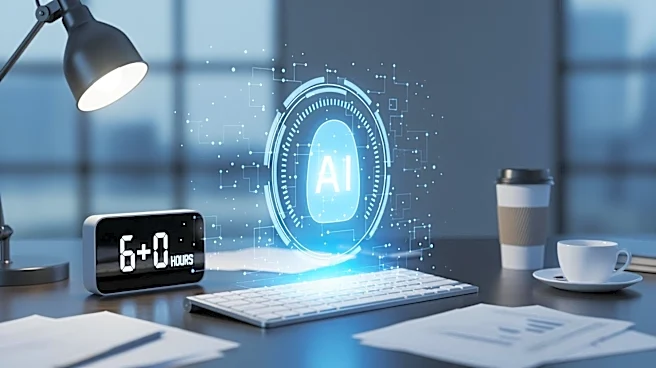
creating new forms of busywork. The survey found that AI saves workers an average of 11 hours per week by automating routine tasks. However, employees are spending over six hours weekly 'botsitting'—monitoring and correcting AI outputs. Despite 75% of individuals reporting increased productivity, only 13% of organizations have seen substantial business growth from AI adoption. The study highlights that the time spent managing AI tools often offsets the productivity gains, as workers need to correct errors and gather necessary information for AI to function effectively.
Why It's Important?
The findings underscore a critical challenge in the integration of AI into business operations. While AI has the potential to enhance productivity by automating mundane tasks, the necessity for human oversight and correction can diminish these benefits. This situation presents a paradox where AI, intended to reduce workload, inadvertently increases it through the need for constant supervision. The limited translation of productivity gains into business growth suggests that companies may not be fully leveraging AI's potential. This could impact economic stakeholders, as businesses may not achieve the expected return on investment from AI technologies. The study indicates a need for organizations to develop strategies that maximize AI benefits while minimizing the associated busywork.
What's Next?
Organizations may need to reassess their AI implementation strategies to better integrate these technologies into their workflows. This could involve training employees to effectively manage AI tools and developing systems that reduce the need for extensive human intervention. Companies might also explore ways to enhance AI accuracy and reliability, thereby reducing the time spent on 'botsitting'. As AI continues to evolve, businesses will likely need to adapt their operational models to fully capitalize on AI's potential, potentially leading to a shift in workforce roles and responsibilities.