

What's Happening?
Nvidia has developed an always-on computer vision system capable of detecting human faces in less than a millisecond. This system, presented at the IEEE International Solid State Circuits Conference, is designed to be integrated into devices such as robots,
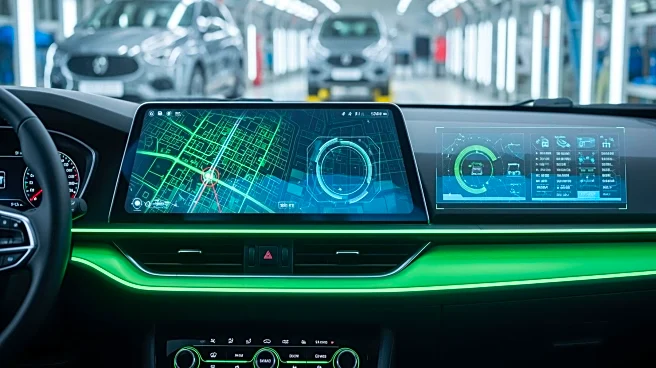
autonomous vehicles, and laptops. The chip, known as the 'Always-on Low-Power Accelerator' or Alpha-Vision, uses a deep neural network to recognize faces with about 99% accuracy while consuming less than 5 milliwatts of power. The system is designed to save energy by storing data locally and quickly entering a low-power sleep mode after detections, a process referred to as 'race to sleep'.
Why It's Important?
This advancement in face detection technology has significant implications for energy efficiency in consumer electronics and autonomous systems. By reducing power consumption, the chip can enable devices to operate continuously without draining battery life, making it ideal for applications in laptops, drones, and robotics. The ability to detect faces rapidly and accurately can enhance user experience by allowing devices to respond seamlessly to user presence, such as turning screens on or off automatically. This technology could also play a crucial role in the development of autonomous vehicles, providing always-on vision capabilities that improve safety and functionality.
What's Next?
Nvidia's new chip is poised to transform how devices interact with users and their environment. As the technology is integrated into more products, it could lead to widespread adoption in various industries, from consumer electronics to automotive. The potential for energy savings and enhanced user experience may drive further innovation and development in the field of computer vision. Additionally, as the technology matures, it could open up new possibilities for applications in security, surveillance, and smart home devices, further expanding Nvidia's influence in the tech industry.