






What's Happening?
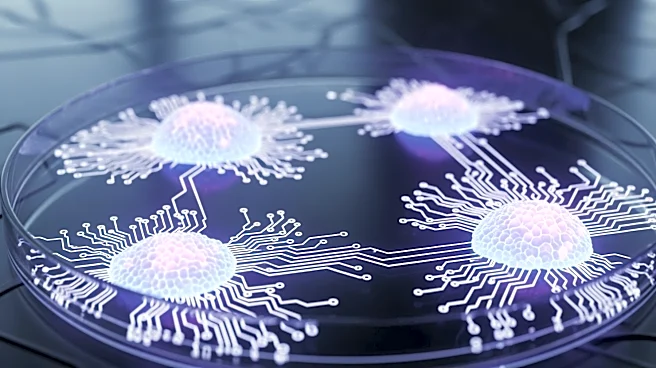
Cortical Labs, an Australian biotech company, has successfully trained lab-grown human brain cells to play the 1990s video game 'Doom'. This innovative research involves using a silicon computer chip embedded with approximately 200,000 living human brain cells,
which are cultivated from stem cells derived from blood donations. The brain cells, initially trained on simpler games like 'Pong', have now advanced to navigating the complex 3D environment of 'Doom', where they must explore and eliminate enemies. The neurons are stimulated by specific electrodes that translate the game's digital environment into electrical signals the cells can interpret. This allows the neurons to adapt in real-time and perform goal-directed learning, demonstrating their potential beyond traditional computing applications.
Why It's Important?
This development signifies a major leap in the field of biotechnology and computing, as it showcases the potential of biological computers to perform complex tasks traditionally handled by artificial intelligence. The use of human brain cells in computing could lead to more sustainable and efficient forms of intelligence, as the human brain operates on significantly less power than conventional silicon-based computing systems. This research could pave the way for advancements in various fields, including drug screening, disease modeling, and personalized medicine, by leveraging the adaptability and learning capabilities of neural cultures. The project also highlights the potential for biological systems to complement existing AI technologies, offering new capabilities and efficiencies.
What's Next?
Cortical Labs plans to further explore the capabilities of their biological computers, potentially expanding their applications beyond gaming to include robotics, real-time learning tasks, and healthcare solutions. The company aims to refine the technology to produce more consistent and programmable results, which could revolutionize how computational tasks are approached. As the technology matures, it may attract interest from industries seeking sustainable computing solutions, potentially leading to collaborations or investments in further research and development. The project's success could also inspire similar initiatives, driving innovation in the intersection of biology and technology.
Beyond the Headlines
The ethical implications of using human brain cells in computing are significant and warrant careful consideration. As this technology develops, questions about the consciousness and rights of lab-grown neural cultures may arise, necessitating the establishment of ethical guidelines and regulations. Additionally, the integration of biological systems into computing raises concerns about data privacy and security, as well as the potential for misuse in surveillance or military applications. These considerations will be crucial in shaping the future of biological computing and ensuring its responsible development and deployment.