



What's Happening?
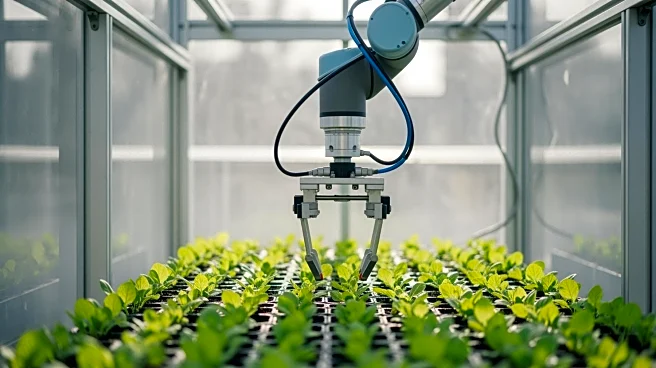
Nithin Aruswamy, a senior at Dublin High School, is leading an agritech startup named Terran, which aims to enhance the productivity and profitability of small-scale farms through an automated hydroponics system. The initiative addresses challenges such as rising water costs and soil degradation, which hinder small-scale farmers from accessing expensive agricultural technology. Terran, co-founded by Aruswamy along with Ethan Chen, Rohan Philip, and Agastya Sidher, has gained national recognition for its innovative business plan. The startup's hydroponics system, although not yet implemented on farms, is designed to increase yield by allowing farmers to grow three times more produce without additional land. This system uses biofertilizers and robotics
to monitor crop growth, making it suitable for indoor or greenhouse environments. Aruswamy's interest in agriculture is deeply rooted in his family's farming background in India.
Why It's Important?
The development of Terran's automated hydroponics system is significant as it offers a potential solution to the challenges faced by small-scale farmers, who produce a substantial portion of the world's food. By increasing yield and reducing dependency on traditional farming methods, this technology could help sustain small-scale farming operations, which are crucial for food security. The system's ability to operate in water-scarce regions also makes it a valuable tool for addressing global agricultural challenges. Furthermore, the recognition Terran has received from various national competitions highlights the growing interest and investment in sustainable agricultural technologies, which could lead to broader adoption and innovation in the sector.
What's Next?
Terran plans to expand its operations within the United States and potentially to other countries facing water scarcity or competition from large agritech companies. The startup is in the process of converting its provisional patent for the SHIELD robotic system into a nonprovisional patent, which could pave the way for commercialization. As Terran continues to develop its technology, it may attract further attention from investors and partners interested in sustainable agriculture solutions. The success of Terran could inspire similar initiatives, fostering a new wave of innovation in the agritech industry.