


What's Happening?
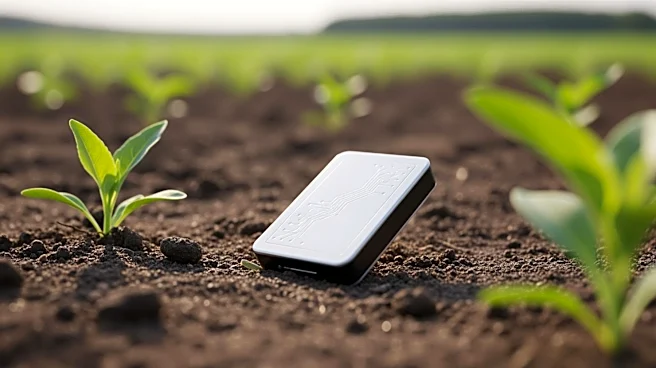
Researchers at Penn State have developed a cost-effective sensor system designed to detect early signs of salt stress in crops. This technology identifies volatile organic compounds (VOCs) emitted by plants under stress, acting as an 'electronic nose'
to warn farmers before visible damage occurs. The system, which uses low-cost metal-oxide semiconductor sensors, was tested in a hydroponic greenhouse environment with arugula plants. The study, led by Ali Ahmad from the Polytechnic University of Valencia, demonstrated the system's ability to accurately identify stress patterns with up to 99.15% accuracy. This innovation addresses the significant issue of soil salinity, which affects nearly 30% of irrigated farmland in the U.S., reducing crop yields and farm profitability.
Why It's Important?
The development of this sensor system is crucial for the agricultural sector, particularly in regions where soil salinity is a major concern. By providing early detection of salt stress, the technology can help farmers take timely action to mitigate damage, potentially improving crop yields and profitability. This is especially important as improper irrigation and saltwater intrusion continue to threaten soil health. The system's affordability and high accuracy make it a viable option for widespread adoption, offering a significant advancement in precision agriculture. Farmers stand to benefit from reduced losses and increased efficiency, while the broader agricultural industry could see improvements in sustainability and resource management.
What's Next?
The next steps for this technology could involve further testing and refinement to ensure its effectiveness across different crop types and environmental conditions. Researchers may also explore integrating the sensor system with existing agricultural technologies to enhance its utility. As awareness of the system grows, adoption by farmers and agricultural businesses could increase, leading to broader implementation. Additionally, policymakers and agricultural organizations might consider supporting initiatives that promote the use of such technologies to address soil salinity issues on a larger scale.