



What's Happening?
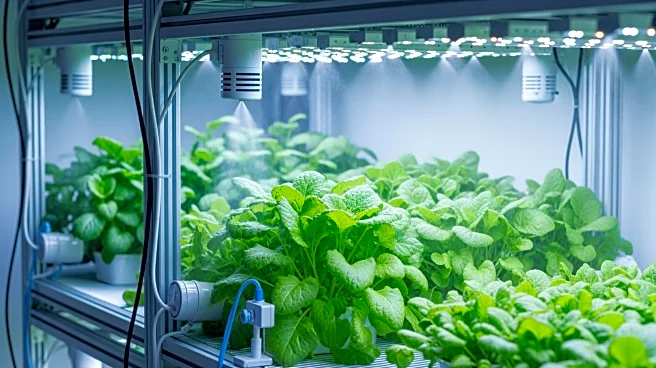
The indoor farming market is experiencing significant growth, with projections indicating it will reach USD 112.93 billion by 2032, growing at a CAGR of 11.2%. This growth is driven by the increasing global population and the rising demand for food, particularly in urban areas. Indoor farming, which utilizes controlled environments like vertical farms and greenhouses, allows for year-round crop production, reducing reliance on traditional farming methods that are vulnerable to climate change and extreme weather. Technologies such as hydroponics, aeroponics, and aquaponics, along with advances in LED lighting and automation, are making indoor farming more scalable and commercially viable. North America is leading the market, supported by strong
investment and consumer demand for fresh produce.
Why It's Important?
The expansion of the indoor farming market is crucial for addressing food security challenges posed by climate change and urbanization. By enabling food production closer to urban consumers, indoor farming reduces the need for long supply chains, improving food availability and reducing waste. The market's growth also supports sustainability goals, as indoor farming uses less water and allows for precise control over nutrients, minimizing environmental impact. The increasing consumer demand for pesticide-free and traceable food further drives the market, offering opportunities for innovation and investment in sustainable agriculture.
What's Next?
As the market continues to grow, there will be increased competition among startups, agribusiness companies, and technology providers, leading to faster innovation. The focus will likely shift towards expanding crop variety and integrating renewable energy solutions to enhance sustainability. Partnerships with retailers and food service companies could also strengthen market positioning. However, challenges such as high energy consumption for lighting and climate control need to be addressed to maximize the environmental benefits of indoor farming.