
What's Happening?
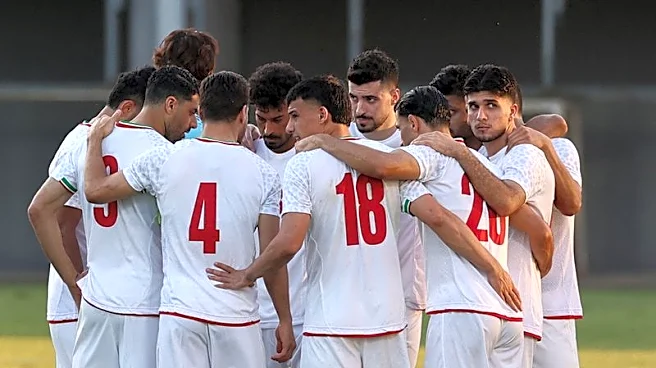
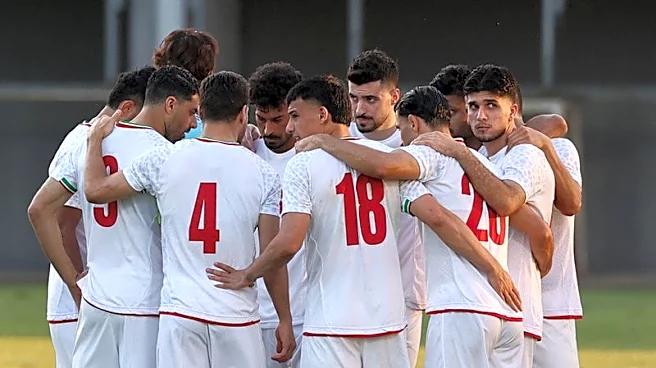
Iran's national football team has been granted visas to enter the United States for the upcoming FIFA World Cup, as confirmed by a White House official. This development comes just 10 days before Iran's opening
match against New Zealand in Los Angeles. The issuance of visas follows a period of uncertainty, with Iran's ambassador to Mexico, Abolfazl Pasandideh, previously stating that the team had not yet received their visas. The US Ambassador to Turkiye, Tom Barrack, praised the U.S. Embassy in Ankara for their efforts in processing the visas. However, some members of the team's technical and administrative staff have not yet received their visas, according to the semi-official Fars news agency. The geopolitical tensions between the US and Iran have added a layer of complexity to the World Cup, with the tournament being used as a platform for political posturing.
Why It's Important?
The granting of visas to Iran's football team is significant as it underscores the complex interplay between sports and international politics. The World Cup, a major global sporting event, is being held in a host nation that is currently in conflict with one of the participating countries, Iran. This situation highlights the challenges of maintaining diplomatic relations and the potential for sports to serve as a bridge in international conflicts. The decision to issue visas, despite ongoing tensions, suggests a willingness to separate sports from political disputes, at least temporarily. However, the exclusion of certain individuals linked to the Islamic Revolutionary Guard Corps from the delegation indicates that political considerations are still influencing decisions.
What's Next?
Iran's football team is scheduled to arrive in Tijuana, Mexico, before heading to Los Angeles for their first match. The team will face New Zealand, Belgium, and Egypt in the group stage. The situation remains delicate, as the US has not formally opposed Iran's participation but has restricted certain individuals from entering. The outcome of the matches and the conduct of the teams could influence diplomatic relations. Additionally, the broader geopolitical context, including ongoing peace talks between the US and Iran, may be affected by the interactions during the World Cup.
Beyond the Headlines
The participation of Iran in the World Cup on US soil, despite the countries being at odds, reflects a broader cultural and diplomatic narrative. It highlights the potential of sports as a unifying force and a platform for dialogue. The decision to allow the team to compete may be seen as a gesture towards peace and a step towards resolving broader conflicts. However, the exclusion of certain individuals and the relocation of the team's base to Mexico indicate underlying tensions and the complexities of international diplomacy.