
What's Happening?
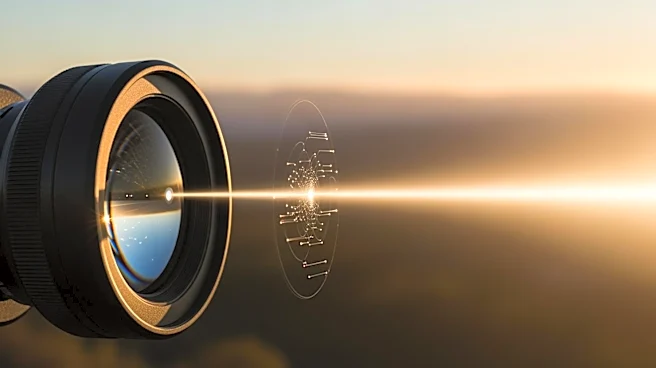
Researchers at Xiamen University have successfully used sunlight to generate quantum-correlated photons, a process previously thought to require stable lasers. This breakthrough was achieved through spontaneous
parametric down-conversion (SPDC), where sunlight was used as the sole pump source. The team employed an automatic sun-tracking device to direct sunlight into a nonlinear crystal, achieving a ghost-imaging visibility of 90.7%. This method, which does not require dedicated electrical power, could support quantum technologies in remote or extreme environments.
Why It's Important?
This development could revolutionize quantum imaging and information systems, particularly in areas where traditional laser systems are impractical. By utilizing sunlight, the approach offers a sustainable and energy-efficient alternative, potentially expanding the reach of quantum technologies. The ability to perform quantum imaging without lasers could lead to advancements in fields such as remote sensing and secure communications, impacting industries reliant on these technologies.
What's Next?
Future research may focus on improving sunlight collection and nonlinear crystal design to enhance imaging speed and quality. Advances in reconstruction methods, such as machine learning, could further refine the technology, bringing it closer to practical applications. The potential for sunlight-powered quantum imaging to operate in space or remote locations suggests a new frontier for quantum research and its applications.