







What's Happening?
The National Laboratory of the Rockies (NLR) has been awarded NASA's 2025 Invention of the Year for its development of an internal short-circuit device (ISC-D) in collaboration with KULR Technology Group. This innovation is designed to improve the safety
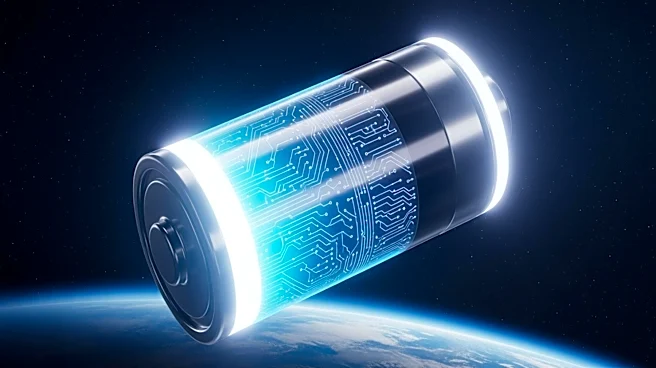
of lithium-ion batteries used in space missions by allowing researchers to intentionally trigger battery failures in a controlled environment. The ISC-D helps simulate internal short circuits, which are critical for understanding and preventing thermal runaway—a dangerous chain reaction that can occur in battery packs. This device is particularly important for space applications, where battery failures can have catastrophic consequences. The ISC-D consists of layered metal discs insulated by wax, which, when heated, trigger a short circuit, allowing scientists to study and mitigate potential failures.
Why It's Important?
The ISC-D's recognition by NASA underscores its significance in enhancing the safety of battery systems used in space exploration. By enabling controlled testing of battery failures, the ISC-D helps ensure that batteries can withstand the extreme conditions of space travel. This innovation is crucial for the safety of astronauts and the success of missions, as it allows for the design of batteries that can prevent the propagation of thermal runaway. The technology is already being used by major companies like SpaceX and Tesla, highlighting its broader impact on industries reliant on advanced battery systems. The ISC-D's ability to improve battery safety could lead to more reliable and safer energy storage solutions across various sectors.
What's Next?
Following the award, the ISC-D technology is expected to see wider adoption in both space and commercial applications. KULR Technology Group is now integrating the ISC-D into battery cells, allowing for comprehensive safety testing at the product level. This approach could streamline safety protocols and enhance the reliability of batteries in consumer electronics, electric vehicles, and aerospace applications. As the demand for safer and more efficient batteries grows, the ISC-D could play a pivotal role in setting new industry standards for battery safety and performance.
Beyond the Headlines
The ISC-D's development highlights the importance of cross-industry collaboration in advancing technology. The partnership between NLR and KULR Technology Group exemplifies how combining expertise from different fields can lead to groundbreaking innovations. This collaboration not only addresses immediate safety concerns but also sets a precedent for future research and development in battery technology. As industries continue to push the boundaries of what is possible with energy storage, the ISC-D serves as a reminder of the critical need for rigorous safety testing and innovation.