







What's Happening?
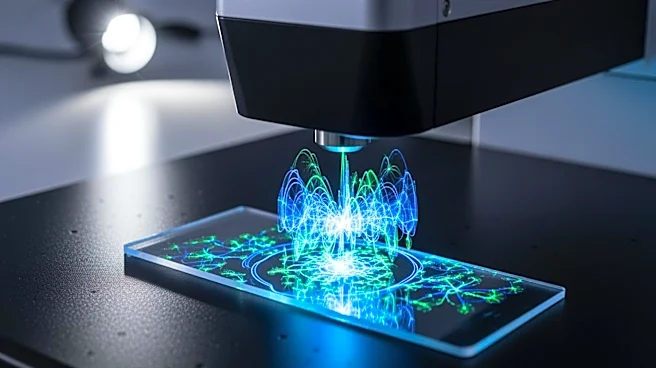
Researchers at the Massachusetts Institute of Technology have developed a new optical phenomenon where chaotic laser light self-organizes into a coherent 'pencil beam.' This breakthrough, published in Nature Methods, uses nonlinear optical interactions
to significantly enhance imaging speed and resolution, allowing real-time observation of biological processes at the cellular level. The self-organizing beam eliminates the need for conventional beam-shaping hardware, representing a major shift in optical imaging. This technology enables high-resolution visualization of processes such as the dynamics of the human blood-brain barrier, offering new insights into therapeutic delivery and cellular interactions.
Why It's Important?
This advancement in optical imaging technology has significant implications for biomedical research and clinical applications. By improving imaging speed and resolution, researchers can gain a deeper understanding of complex biological systems, potentially leading to breakthroughs in disease treatment and drug delivery. The ability to observe cellular processes in real-time without external labels enhances the study of neurodegenerative diseases and other conditions where the blood-brain barrier plays a critical role. This technology could transform drug screening and bioengineering, making it a valuable tool for advancing medical research and improving patient outcomes.