






What's Happening?
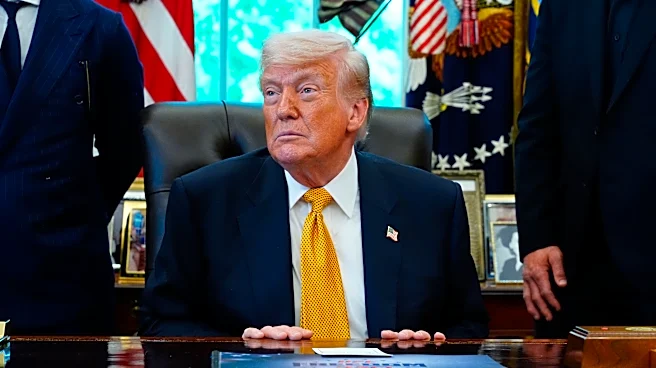
The U.S. Court of International Trade (CIT) has ruled against President Donald Trump's imposition of a 10% global tariff, declaring it unlawful. The tariffs, which were implemented under Section 122 of the Trade Act of 1974, were justified by the administration
as a response to the U.S.'s trade imbalance with global partners. However, the court found that the conditions required for such tariffs, specifically a balance-of-payments deficit, were not met. The ruling came after a lawsuit filed by small businesses, including Burlap and Barrel, a spice importer, and Basic Fun!, a toy company. The court's decision was a 2-1 ruling in favor of the plaintiffs, who argued that the tariffs created significant challenges for their operations and were beyond the President's authority.
Why It's Important?
This ruling is significant as it challenges the scope of presidential power in imposing tariffs under the Trade Act of 1974. The decision provides clarity and stability for American businesses that rely on global supply chains, as it limits the circumstances under which such tariffs can be applied. For small businesses, this ruling is a victory, as it alleviates the financial burden imposed by the tariffs, allowing them to compete more effectively in the global market. The decision also underscores the importance of predictable trade policies for economic growth and stability, particularly for companies that depend on international manufacturing and partnerships.
What's Next?
While the ruling blocks the tariffs for the plaintiffs, the administration may appeal the decision, potentially prolonging the legal battle. Additionally, the administration is exploring other avenues under the Trade Act of 1974, such as Section 301, which could lead to new tariffs based on investigations into forced labor and industrial excess capacity. These investigations could impact a wide range of U.S. trading partners and result in tariffs beyond the initial 10%. The Office of the U.S. Trade Representative is conducting these investigations, with hearings already underway, indicating that further trade policy changes may be forthcoming.