







What's Happening?
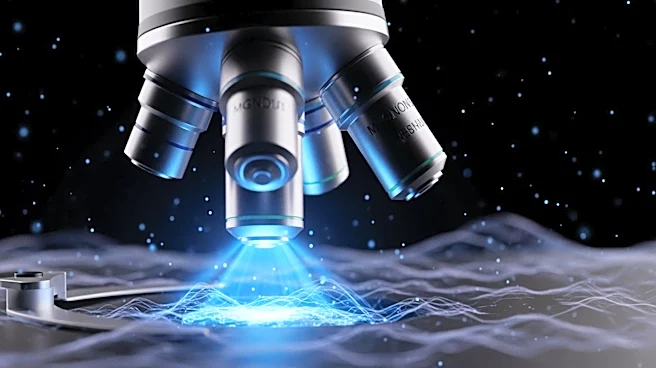
Researchers have successfully used a new technique called magnon momentum microscopy to directly image magnon populations across two-dimensional momentum space. This method, which involves resonant magnetic soft-X-ray scattering, addresses the challenge
of detecting magnons at nanometre wavelengths, where exchange interactions dominate their dynamics. The technique was applied to yttrium iron garnet, revealing a variety of previously unobserved nonlinear magnon interactions. This advancement allows for the exploration of short-wavelength and nonlinear magnonics, potentially advancing wave-based information processing beyond conventional electronics. The method does not rely on electronic detection methods, allowing for more flexible experimental setups.
Why It's Important?
The ability to visualize magnons at the nanometre scale is a significant breakthrough for materials science, particularly in the field of magnonics. Magnons, as quantum units of spin wave energy, have the potential to be used as information carriers in wave-based computing architectures, offering an alternative to conventional electronics. This could lead to advancements in computing technology, surpassing the limitations of current CMOS technology. The technique's ability to detect short-wavelength magnons opens new avenues for research and development in information processing and materials science, potentially impacting industries reliant on advanced computing technologies.
What's Next?
The development of magnon momentum microscopy could lead to further research into the dynamics of magnons and their potential applications in computing. Researchers may explore the use of this technique with other materials and in different experimental setups to better understand magnon interactions. The findings could influence the design of new computing architectures and devices, potentially leading to more efficient and powerful computing solutions. As the technique becomes more widely adopted, it may also inspire further innovations in the field of magnonics and related areas of materials science.