








What's Happening?
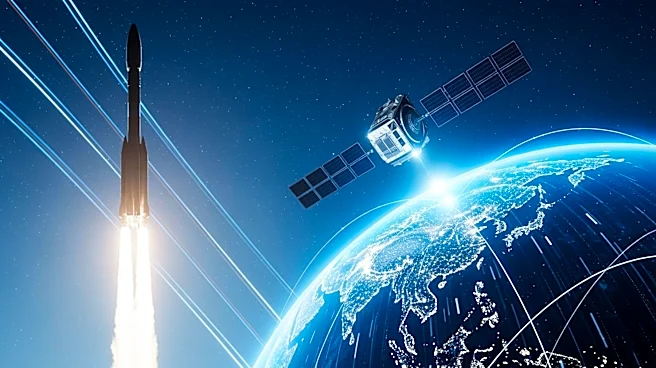
SpaceX is set to launch its Falcon Heavy rocket for the first time in 18 months, carrying the ViaSat-3 F3 communications satellite. The launch is scheduled from NASA's Kennedy Space Center in Florida on April 27. The Falcon Heavy, known for its powerful
thrust, will deploy the 6.6-ton satellite into geostationary orbit, providing high-throughput broadband service to the Asia-Pacific region. This mission marks the completion of the ViaSat-3 mini-constellation, following previous launches of ViaSat-3 F1 and F2. The two side boosters of the Falcon Heavy are expected to return to Cape Canaveral Space Force Station, while the central booster will not be recovered.
Why It's Important?
The launch of the ViaSat-3 F3 satellite is significant for expanding broadband services in the Asia-Pacific region, enhancing connectivity and internet access. This development is crucial for commercial, defense, and consumer sectors, offering fast and reliable broadband. The successful deployment of the satellite will complete the ViaSat-3 mini-constellation, which aims to provide comprehensive coverage across different regions. The mission also highlights SpaceX's continued innovation and capability in launching heavy payloads, reinforcing its position in the aerospace industry.
What's Next?
Following the launch, the ViaSat-3 F3 satellite will be positioned in geostationary orbit to begin its service. The successful deployment will enable ViaSat to offer enhanced broadband services, potentially leading to increased market competition and improved internet access in underserved areas. SpaceX will continue to focus on its upcoming missions, including further development of its Starship rocket, which promises even greater payload capacity.