
What's Happening?
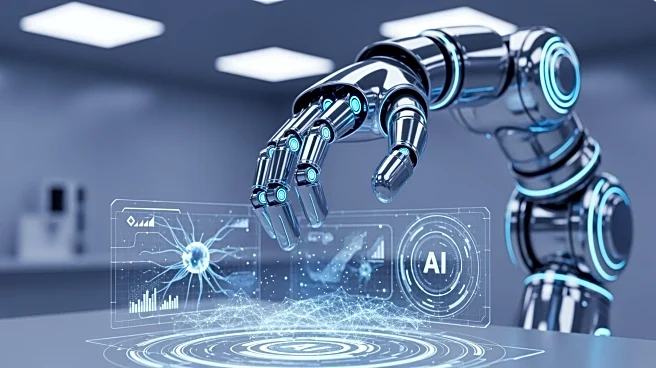
Universal Robots has outlined four key predictions for the future of robotics, emphasizing the role of artificial intelligence (AI) in transforming industrial automation by 2026. The company anticipates
significant advancements in predictive math, imitation learning, purpose-built AI applications, and data-driven strategies. These developments are expected to enhance the capabilities of robots, allowing them to anticipate changes, learn from human and peer interactions, and perform complex tasks with greater efficiency. The integration of task-specific AI applications is projected to become standard in robotic systems, facilitating processes like welding, assembly, and inspection. Additionally, the creation of secure data exchanges is expected to enable AI developers to access anonymized performance data, fostering innovation and improving AI tools.
Why It's Important?
The predictions by Universal Robots highlight a transformative shift in the robotics industry, with AI playing a central role in enhancing productivity and efficiency. The anticipated advancements could significantly impact various sectors, including manufacturing, logistics, and retail, by enabling robots to perform tasks traditionally resistant to automation. This evolution is likely to lead to faster workflow configurations, improved resilience to changing conditions, and more intuitive human-robot collaboration. The focus on task-specific AI applications and data-driven strategies could also drive innovation, offering new revenue streams for manufacturers and better AI tools for customers. As these technologies mature, they promise to redefine the landscape of industrial automation, making it more adaptive and efficient.
What's Next?
As the robotics industry moves towards these predicted advancements, stakeholders can expect increased investments in AI-driven technologies and the development of secure data exchanges. Manufacturers may focus on integrating task-specific AI applications into their robotic systems, while AI developers could leverage anonymized data to enhance their models. The adoption of imitation learning and predictive math techniques is likely to accelerate, leading to more collaborative and adaptive robotic systems. As these technologies become more widespread, industries may experience a shift towards more efficient and resilient operations, with robots playing a crucial role in optimizing processes and reducing costs.