







What's Happening?
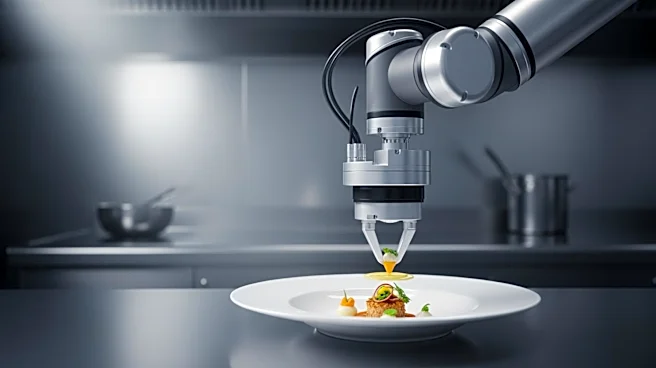
Chef Robotics has announced a significant achievement in the deployment of its physical AI technology within the food manufacturing sector. The company reported that its robots have successfully completed 100 million servings in production at various
customer facilities. This milestone is claimed to be an order of magnitude greater than the output of all other food robotics companies combined. The deployments span over a dozen production facilities across the United States, Canada, and Europe. Chef Robotics has also amassed the world's largest dataset for real-world food manipulation and deformable material training data, surpassing other physical AI companies. The company's approach involves training models on real-world production data from manufacturing facilities, focusing on tasks such as portioning and assembly, rather than relying on simulation or lab data.
Why It's Important?
The deployment of physical AI by Chef Robotics represents a significant advancement in the automation of food manufacturing processes. By achieving such a high volume of production, the company demonstrates the potential for robotics to enhance efficiency and consistency in food production. This development could lead to reduced labor costs and increased production capacity, benefiting food manufacturers and potentially leading to lower prices for consumers. Additionally, the use of real-world data for training AI models could improve the adaptability and precision of robotic systems, setting a new standard for automation in the industry. The success of Chef Robotics may encourage further investment and innovation in the field of food manufacturing automation.
What's Next?
As Chef Robotics continues to expand its deployments, the company may seek to enhance its technology to handle more complex tasks within food manufacturing. This could involve refining its AI models to improve accuracy and efficiency further. The success of these deployments might also prompt other companies in the food industry to adopt similar technologies, potentially leading to a broader transformation in manufacturing practices. Additionally, regulatory bodies may begin to establish guidelines and standards for the use of AI in food production, ensuring safety and quality in automated processes.