







What's Happening?
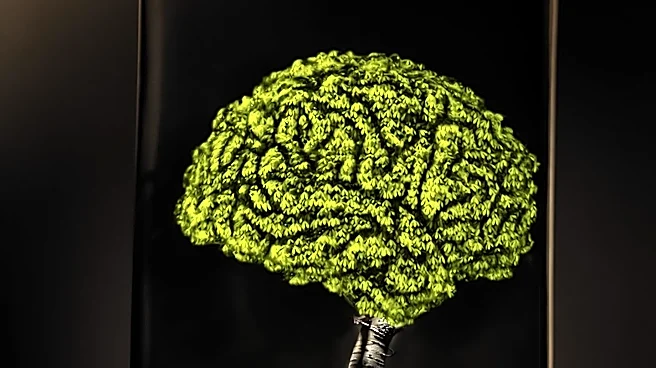
Nelson Dellis, a six-time US memory champion, has been the subject of a detailed brain study revealing the techniques behind his exceptional memory skills. Dellis, who can memorize a shuffled deck of cards in under a minute and recall 10,000 digits of pi,
uses methods like the method of loci, which involves associating information with specific locations. Brain scans conducted by researchers at Washington University in St. Louis showed that Dellis' brain activity during memory tasks involves areas linked to navigation and visual information. The study aims to bridge the gap between memory athletes' techniques and scientific understanding.
Why It's Important?
The study of Dellis' brain provides insights into how extraordinary memory can be developed and the potential applications of these techniques in educational and clinical settings. Understanding the neural mechanisms behind memory champions' skills could lead to improved memory training methods for the general population. The research highlights the importance of visual and spatial memory techniques, which could be integrated into learning strategies to enhance cognitive performance. This study also contributes to the broader understanding of human memory and its potential for improvement.
Beyond the Headlines
The findings suggest that memory techniques like the method of loci tap into evolutionary strengths related to navigation and spatial awareness. This approach could be particularly beneficial in educational contexts, where traditional rote memorization is less effective. The study also raises questions about the extent to which these techniques can be generalized to others and the role of individual differences in memory capacity. Further research could explore how lifestyle factors, such as exercise and diet, contribute to memory enhancement.