
What's Happening?
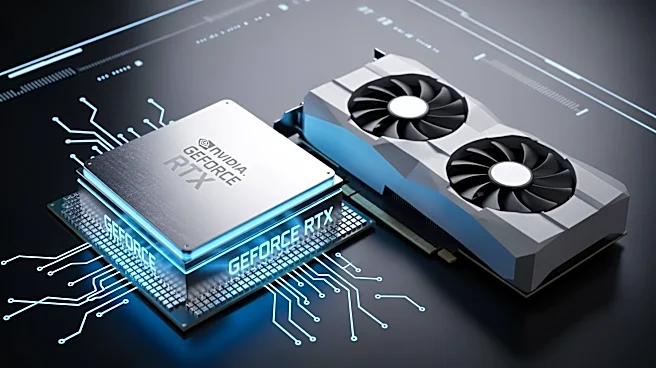
Nvidia has announced a significant advancement in its AI-RAN strategy with the development of a new chip designed for 6G radio units (RUs). This move is part of Nvidia's broader effort to integrate its graphics
processing units (GPUs) into various sectors, including telecommunications. The new chip aims to replace the application-specific integrated circuits (ASICs) traditionally used in RUs, which are essential for handling the complex processing demands of advanced network technologies like massive MIMO and ultra-MIMO. These technologies require substantial computational power due to the increased number of transmitters and receivers, potentially reaching up to 1,024 in 6G applications. Nvidia's approach involves using GPUs to manage these demands, offering a more flexible and software-defined platform compared to fixed-function silicon.
Why It's Important?
The introduction of Nvidia's GPU-based solution for 6G RUs could significantly impact the telecommunications industry by providing a more adaptable and scalable computing platform. This development is crucial as it addresses the growing computational needs of next-generation networks, which are expected to support a wide range of applications, including AI-driven services. By leveraging GPUs, Nvidia aims to offer a solution that can evolve with technological standards and deployment models, potentially reducing the reliance on custom silicon that is costly and limited to specific applications. This shift could lead to more efficient network operations and open up new opportunities for innovation in the telecom sector.
What's Next?
As Nvidia continues to develop its AI-RAN strategy, the next steps will likely involve further integration of its GPUs into the telecommunications infrastructure. This could include collaborations with other technology companies to enhance compatibility and performance. Additionally, the industry will be watching closely to see how telecom operators respond to this new technology and whether they adopt Nvidia's solution for their 5G and 6G networks. The success of this initiative could influence future investments in network infrastructure and drive further advancements in AI-driven telecommunications.
Beyond the Headlines
Nvidia's move to introduce GPUs into the RAN space highlights a broader trend towards software-defined networking, which allows for greater flexibility and adaptability in network management. This shift could have long-term implications for the telecom industry, potentially leading to more open and interoperable network architectures. Moreover, the collaboration between Nvidia and companies like Marvell suggests a growing interest in combining AI capabilities with traditional network functions, paving the way for more intelligent and responsive network systems.