







What's Happening?
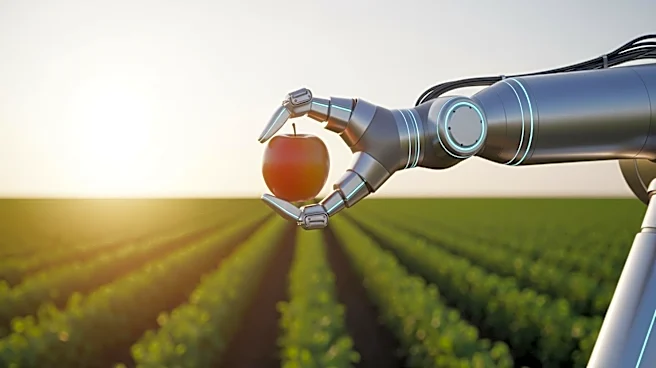
The global market for harvesting robots is expected to grow significantly, reaching USD 1.45 billion by 2030, according to a report by Data Bridge Market Research. This growth is driven by a compound annual growth rate (CAGR) of 10.50% from 2026 to 2030.
The increasing demand for automation in agriculture, coupled with labor shortages and advancements in AI-powered robotic systems, are key factors contributing to this expansion. The market is witnessing a steady rise due to the need for precision farming, growing global food demand, and the adoption of smart agricultural technologies. Government initiatives promoting agri-tech adoption and investments in autonomous farming solutions are further supporting market growth. North America currently holds the largest market share, while Asia-Pacific is the fastest-growing region, driven by mechanization demand and government subsidies in countries like China and India.
Why It's Important?
The expansion of the harvesting robots market is significant for several reasons. It addresses the critical issue of labor shortages in agriculture, particularly in regions like North America and Europe, where urban migration and aging farming populations are prevalent. By automating labor-intensive tasks, these robots enhance efficiency and reduce dependency on seasonal workers. Additionally, the integration of AI and machine vision technologies improves the accuracy and efficiency of these robots, enabling them to operate in complex environments and identify ripe produce with minimal damage. This technological advancement supports the broader trend of precision agriculture, which aims to optimize crop yields and resource efficiency. As global food demand continues to rise, harvesting robots offer a scalable solution to increase agricultural output while minimizing resource input.
What's Next?
Looking ahead, the market for harvesting robots is poised for further growth as technological innovations continue to enhance their capabilities. The integration of these robots with smart farming ecosystems, including IoT platforms and farm management software, presents opportunities for end-to-end farm automation. This integration will likely enhance operational efficiency and provide real-time data insights, further driving adoption. Additionally, strategic partnerships and collaborations between agri-tech companies, research institutions, and governments are expected to accelerate innovation and market expansion. As the demand for high-value crops increases, precision harvesting solutions will create new revenue streams for market players. However, challenges such as high initial investment costs and technical limitations in complex environments may need to be addressed to ensure widespread adoption.