






What's Happening?
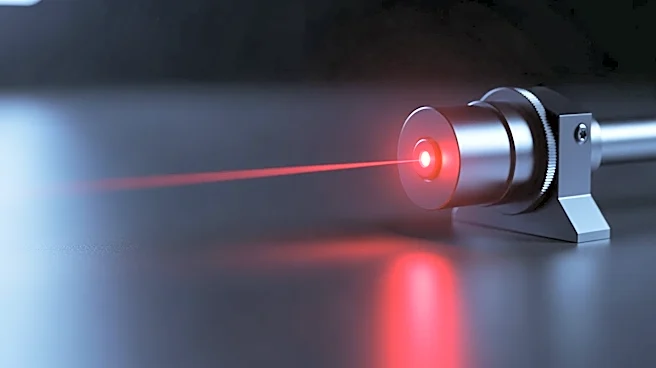
Asahi Kasei Microdevices Corporation (AKM), in collaboration with Kyoto University, has successfully achieved laser oscillation in a 2 µm-band infrared photonic crystal surface-emitting laser (PCSEL). This development is significant for the miniaturization
of next-generation sensing systems, maintaining high directionality and narrow spectral bandwidth. The technology, initially developed in the early 2000s, offers higher functionality in a compact device, making it suitable for applications like biomolecule sensing and breath gas analysis. AKM plans to accelerate research and development of this technology, focusing on manufacturability and advanced photonic crystal designs.
Why It's Important?
The advancement in PCSEL technology is crucial for high-sensitivity applications such as greenhouse gas detection, as the 2 µm wavelength band includes absorption lines for gases like CO2 and CH4. This could lead to more precise environmental monitoring and industrial applications. The collaboration between AKM and Kyoto University highlights the potential for innovation in optical sensing technologies, which could impact various sectors, including healthcare, environmental monitoring, and industrial automation.
What's Next?
AKM intends to continue its research and development efforts to enhance the manufacturability and design of 2 µm-band PCSEL technology. This could lead to broader adoption in industries requiring precise optical control and high power. The ongoing collaboration with Kyoto University may yield further innovations, potentially expanding the range of applications for this technology.