
What's Happening?
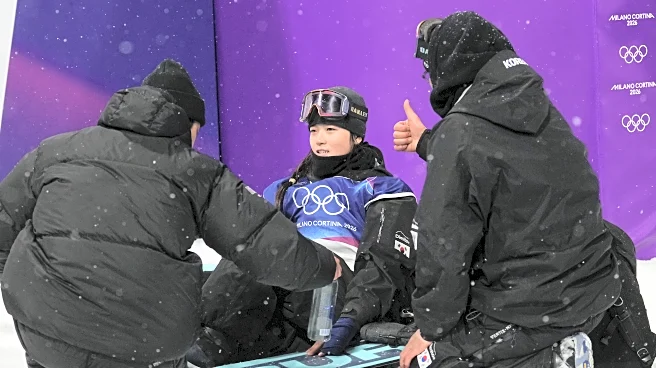
Chloe Kim, a prominent American snowboarder, recently secured a silver medal in the women's halfpipe event at the 2026 Winter Olympics held in Livigno, Italy. Despite her impressive performance, questions
have arisen regarding the scoring of her runs. Kim, who is a two-time Olympic gold medalist, initially led with a score of 88.0 after her first run. However, 17-year-old Choi Ga-on from South Korea surpassed her with a score of 90.25 on her final run. Kim attempted to reclaim the lead but fell during her subsequent runs. The controversy centers around the difficulty of Kim's tricks, particularly her execution of a double-cork 1080, which some commentators and fans believe warranted a higher score. NBC commentator Todd Richards expressed surprise at the scoring, suggesting that Kim's initial score might have been underestimated with the expectation of a more significant performance in later runs.
Why It's Important?
The controversy surrounding Chloe Kim's scoring highlights ongoing debates about judging standards in Olympic snowboarding events. This incident underscores the subjective nature of scoring in sports that rely heavily on technical execution and artistic impression. The outcome not only affects the athletes' standings but also influences public perception of fairness in competitive sports. For Kim, who has been a dominant figure in snowboarding, the silver medal represents both a personal and professional challenge, as she navigates the expectations of maintaining her top-tier status. The situation also brings attention to the potential need for more transparent and consistent judging criteria, which could impact future competitions and the development of the sport.
What's Next?
As the Winter Olympics continue, discussions about scoring practices in snowboarding and other judged sports are likely to intensify. Stakeholders, including athletes, coaches, and sports organizations, may advocate for reforms to ensure fairer and more transparent judging processes. Chloe Kim, despite the setback, remains a key figure in snowboarding and is expected to continue competing at the highest levels. Her experience may influence future athletes and contribute to ongoing conversations about the evolution of snowboarding as a competitive sport.