
What's Happening?
Cartwheel, a new 3D animation startup founded by Andrew Carr and Jonathan Jarvis, is working to transform the animation industry by integrating AI technology that allows for greater creative control. Unlike
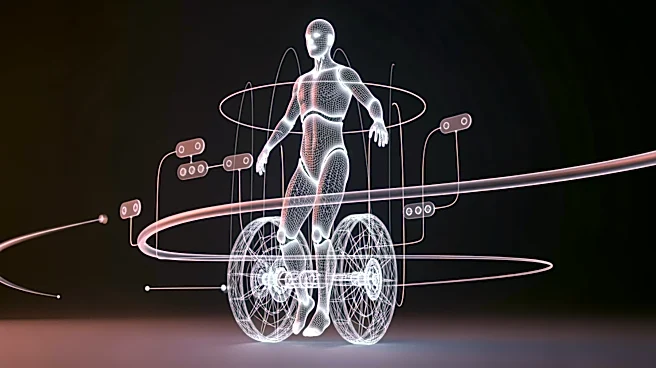
traditional generative AI models that produce final outputs with limited user intervention, Cartwheel's approach focuses on creating a 'control layer' where AI-generated 3D data serves as a starting point for further artistic manipulation. This method aims to address the issue of 'sameness' in AI-generated content by enabling animators to edit and personalize the output, thus preserving the creative essence of animation. The company has spent years developing models that map human movement, allowing simple 2D videos to be transformed into realistic 3D skeletons, providing animators with the tools to create more dynamic and personalized animations.
Why It's Important?
The introduction of Cartwheel's technology could significantly impact the animation industry by lowering barriers to entry and speeding up production processes. By offering a system where AI handles technical tasks while artists retain creative control, Cartwheel is addressing a major concern in the AI community: the loss of artistic individuality. This innovation could lead to more diverse and personalized content in gaming, social media, and other digital platforms, where the demand for unique and engaging animations is rapidly increasing. Furthermore, Cartwheel's focus on 'open-ended storytelling' and 'open-ended world-building' could redefine how digital narratives are created, allowing for more interactive and responsive characters in virtual environments.
What's Next?
Cartwheel plans to continue developing its technology to further bridge the gap between 2D vision and 3D execution. The company envisions a future where 3D animation becomes the standard, even if the final output is in 2D. As Cartwheel's models evolve, they aim to enable characters to react and perform in real-time, enhancing the realism and interactivity of digital content. This could lead to new opportunities in various sectors, including gaming and virtual reality, where dynamic and responsive animations are crucial. The success of Cartwheel's approach may also inspire other companies to adopt similar strategies, potentially leading to widespread changes in the animation industry.
Beyond the Headlines
Cartwheel's approach to animation not only addresses technical challenges but also raises important ethical and cultural considerations. By empowering artists to maintain control over AI-generated content, the company is advocating for a balance between automation and human creativity. This could influence broader discussions about the role of AI in creative industries, where concerns about the homogenization of content and the displacement of human artists are prevalent. Additionally, Cartwheel's focus on mapping human movement highlights the importance of understanding and preserving the nuances of human expression in digital formats, which could have implications for how AI is used in other fields, such as virtual reality and human-computer interaction.