






What's Happening?
Standard Bots has announced a successful Series C funding round, raising $200 million and bringing its valuation to $1 billion. The company plans to use this investment to expand its manufacturing operations in New York, enhancing its capacity to design,
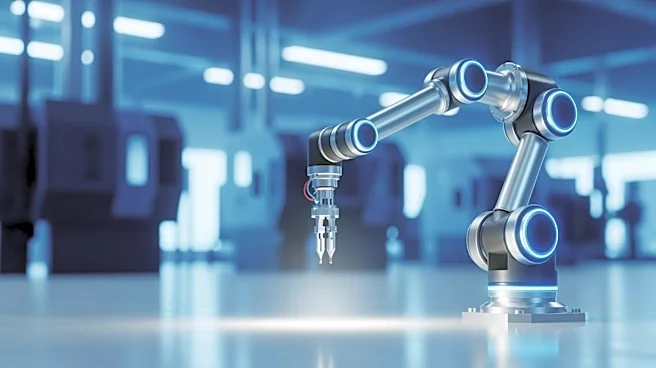
assemble, and deploy American-made robots. Co-founder and CEO Evan Beard emphasized the role of AI-native robots as essential tools for the 21st century, capable of performing a wide range of tasks autonomously. The funding round was led by RoboStrategy and other existing investors. Standard Bots specializes in creating AI-native robot arms and industrial humanoids that require no coding for deployment across various applications, including machining, welding, and assembly. The company serves a diverse clientele, from Fortune 100 companies to small and midsize manufacturers across the U.S.
Why It's Important?
The expansion of Standard Bots' manufacturing capabilities is significant for the U.S. economy, particularly in the manufacturing sector, which accounts for a substantial portion of American jobs. The U.S. has seen a decline in manufacturing jobs over the decades, partly due to global competition and the outsourcing of production to countries like China, which has heavily invested in robotics. By increasing the domestic production of industrial robots, Standard Bots aims to make U.S. manufacturers more competitive globally. The company's efforts align with broader national strategies to revitalize American manufacturing and reduce reliance on foreign-made robotics. This move could potentially lead to job creation and economic growth within the U.S. manufacturing sector.
What's Next?
Standard Bots is set to expand its facility in Glen Cove, New York, to accommodate the growing demand for its robots. The company is on track to deliver 10% of new U.S. industrial robot deployments by next year. Additionally, Standard Bots is actively involved in advising the White House and Congress on a National Robotics Strategy, advocating for financial support for American manufacturers and restrictions on Chinese-made robotics. These efforts could influence future policy decisions and further bolster the domestic robotics industry.