


What's Happening?
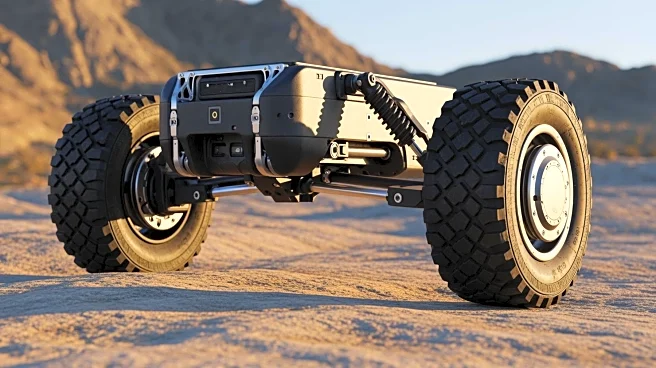
SteerAI has launched the xRift, a fully autonomous all-terrain vehicle designed to operate in challenging environments such as the Gulf region. The xRift features a cab-less utility architecture and is powered by CoreX, an AI-driven autonomous driving
system. This system allows the vehicle to navigate, perceive, and make decisions without human intervention, making it suitable for high-risk environments. The xRift is equipped with a 225 HP liquid-cooled engine and can reach speeds of up to 50 km/h. It is designed to carry diverse payloads, including intelligence and surveillance modules, across rugged landscapes. The vehicle's foundational technology was developed by the Technology Innovation Institute in Abu Dhabi and scaled by SteerAI. The xRift is expected to be ready for deployment by the end of 2026.
Why It's Important?
The introduction of the xRift represents a significant advancement in autonomous vehicle technology, particularly for off-road applications. This development could have substantial implications for industries such as defense and logistics, where autonomous solutions can enhance operational efficiency and safety. By removing the need for human drivers in hazardous conditions, the xRift could reduce the risk of accidents and improve mission success rates. Additionally, the vehicle's versatility and ability to carry various payloads make it a valuable asset for multiple applications, from supply runs to surveillance operations. This innovation underscores the growing trend towards automation and AI integration in industrial sectors.
What's Next?
SteerAI plans to have production units of the xRift ready for deployment by the end of 2026. As the vehicle enters the market, it is likely to attract interest from military and commercial sectors looking to enhance their operational capabilities in challenging environments. The success of the xRift could lead to further developments in autonomous vehicle technology, potentially expanding its applications beyond the current scope. Stakeholders in the defense and logistics industries may closely monitor the vehicle's performance and consider integrating similar technologies into their operations.