
Close your eyes and picture the 'First Thanksgiving.' You see Pilgrims in black hats and Wampanoag people in feathered headdresses, right? That image, cemented in our minds, is mostly a myth, born from a painting made 300 years after the fact.
The Mythic Painting
The picture in your head is almost certainly based on Jean Leon Gerome Ferris’s painting, ‘The First Thanksgiving 1621’. It’s a warm, harmonious scene of two cultures sharing a meal. The only problem? It was painted around 1915, not 1621. It was part of a series called 'The Pageant of a Nation,' designed to create a romantic, heroic, and unified story of American history. This was especially popular during the Colonial Revival movement of the late 19th and early 20th centuries, a time of massive immigration
and social change when many white Americans looked back to a simplified, idealized past to define a national identity. Ferris's art was less a historical document and more a piece of cultural myth-making.
Myth: Black Clothes and Buckled Hats
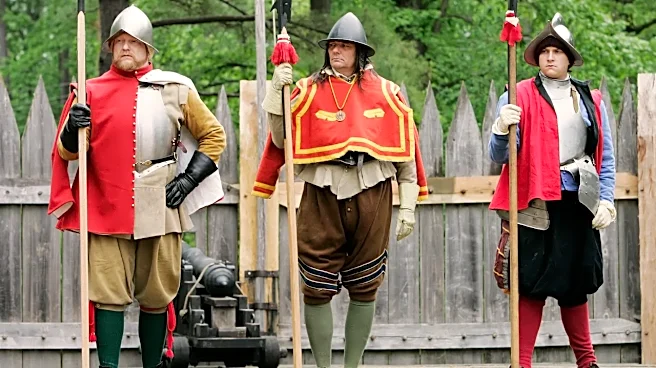
The painting, and countless school plays since, depicts the Pilgrims in somber black clothing with large white collars and cuffs, and big buckles on their hats and shoes. This has become the go-to uniform for any Thanksgiving pageant. In reality, this portrayal is wildly inaccurate. Black dye was expensive and typically reserved for formal occasions or Sundays. For a harvest celebration, colonists would have worn clothing in a variety of colors, including reds, greens, blues, and browns, dyed from available plant materials. Their estate inventories list items like 'a red petticoat' and 'a violet cloak'. And those iconic buckles? They weren't in fashion until much later in the 17th century. The Pilgrims wore practical leather shoes called 'latchets,' which tied on with straps.
Myth: The Generic 'Indian' Costume
Just as the Pilgrim attire is wrong, the depiction of the Wampanoag people is a harmful stereotype. Ferris's painting shows the Native men with large, feathered headdresses, a style more associated with Plains tribes of the American West. The Wampanoag, a people of the Eastern Woodlands, did not wear these elaborate headdresses. A chief might wear a couple of feathers standing upright in a headband, but not the flowing war bonnets seen in the painting. Wampanoag men typically wore deerskin breechcloths, and women wore deerskin skirts. In cooler weather, both would wear mantles of animal skin. The painting’s costume choice erases the Wampanoag’s distinct culture, lumping them into a generic, fictionalized image of 'Indian-ness'.
Myth: A Planned, Peaceful Potluck
The painting presents a serene gathering, a pre-planned dinner between friends. The actual historical event was more complicated and less formal. The English colonists, celebrating their first successful harvest, fired their guns in a military-style exercise. Hearing the shots, about 90 Wampanoag men, led by their leader Ousamequin (also known as Massasoit), arrived, likely concerned and investigating a potential attack. Their meeting was more of an impromptu diplomatic encounter than a scheduled feast. The Wampanoag, who generously contributed five deer to the multi-day event, outnumbered the roughly 50 colonists almost two-to-one. The gathering was a moment of mutual need within a fragile alliance, not the simple, happy meal of the painting.
Myth: The Birth of a Holiday
The 1621 harvest feast was not called 'Thanksgiving' by those who attended, nor did it immediately become an annual tradition. For the Pilgrims, a 'thanksgiving' was a solemn religious day of prayer and sometimes fasting, not a harvest festival. The 1621 event was a secular celebration. The idea of connecting this specific meal to a national holiday came much, much later. In 1863, in the midst of the Civil War, President Abraham Lincoln declared a national Thanksgiving holiday, largely due to the tireless campaigning of magazine editor Sarah Josepha Hale. The goal was to foster unity in a deeply divided nation. It was only then, in the 19th century, that the Pilgrim story was retroactively attached to the holiday to create a powerful, shared origin story for all Americans.