






The STS-49 mission, launched on May 7, 1992, marked a significant milestone in the history of NASA's Space Shuttle program. As the maiden flight of the Space Shuttle Endeavour, the mission was a showcase of technical achievements and innovations that would influence future space exploration endeavors. The successful retrieval and relaunch of the Intelsat VI satellite demonstrated the capabilities of the shuttle and its crew in conducting complex operations
in space.
Innovations in Satellite Retrieval
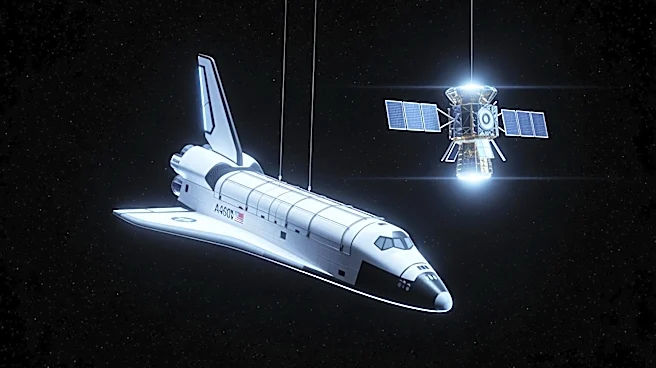
One of the key technical achievements of the STS-49 mission was the successful retrieval and relaunch of the Intelsat VI satellite. The satellite had been stranded in an unusable orbit since its launch in March 1990, and the mission aimed to capture it and attach it to a new perigee kick motor for relaunch. This task required precise maneuvering and coordination among the crew members, showcasing the shuttle's capabilities in conducting complex satellite operations.
The mission featured the first and only three-person extravehicular activity (EVA) in space flight history, highlighting the innovative approach taken by the crew to overcome the challenges of satellite retrieval. The Assembly of Station by EVA Methods (ASEM) structure was erected in the cargo bay to aid in the hand capture and subsequent attachment of the capture bar, demonstrating the shuttle's versatility in adapting to unforeseen challenges.
Record-Breaking Spacewalks
STS-49 set several records in the realm of spacewalks, underscoring the technical achievements of the mission. The third EVA, conducted by astronauts Pierre Thuot, Richard Hieb, and Thomas Akers, lasted 8 hours and 29 minutes, making it the longest U.S. spacewalk at the time. This record stood until STS-102 in 2001, highlighting the endurance and skill required for such complex operations.
The mission also featured the second and fourth longest EVAs to date, with durations of 8 hours, 29 minutes, and 7 hours, 45 minutes, respectively. These extended spacewalks were crucial for the successful completion of the mission objectives, including the assembly of the ASEM structure in the cargo bay.
Legacy of Technical Excellence
The technical achievements of the STS-49 mission had a lasting impact on future space exploration endeavors. The mission demonstrated the feasibility of extended EVAs and complex satellite operations, paving the way for more ambitious missions involving satellite servicing and space station assembly.
The pioneering efforts of the STS-49 crew contributed to the development of techniques and technologies that would be used in future missions. The mission's legacy continues to influence the planning and execution of complex operations in space, showcasing the potential for innovation and technical excellence in overcoming challenges.
Overall, STS-49 was a landmark mission that highlighted the capabilities of the Space Shuttle program, setting new standards for technical achievements and paving the way for future advancements in space exploration.