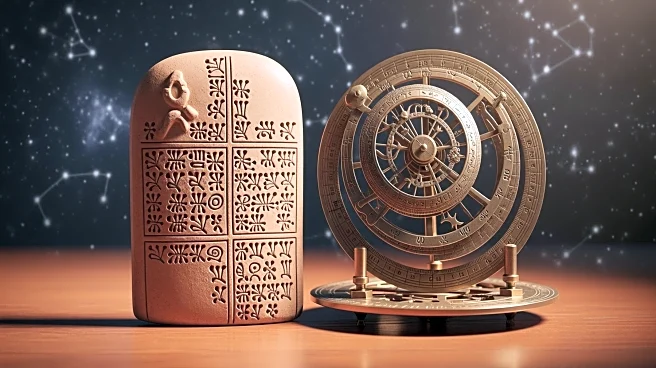




Astrology, a practice that seeks to interpret celestial phenomena to predict human affairs, has a rich and varied history. Originating in ancient civilizations, astrology was once considered a scholarly tradition intertwined with astronomy and other sciences. However, over time, it has been increasingly viewed as pseudoscience, lacking empirical support. This article explores the historical journey of astrology, highlighting its evolution from ancient practices
to its modern perception.
Ancient Beginnings
Astrology's roots can be traced back to the 2nd millennium BCE, where it emerged from calendrical systems used to predict seasonal shifts. Early evidence of astrological practices appears in markings on bones and cave walls, indicating that lunar cycles were noted as early as 25,000 years ago. These observations were crucial for organizing communal calendars and addressing agricultural needs.
By the 3rd millennium BCE, civilizations had developed sophisticated awareness of celestial cycles, using the rising of star groups to herald annual floods or seasonal activities. Astrology was practiced in Mesopotamia during the Old Babylonian period, around 1800 BCE, and was later elaborated in the Zhou dynasty in China.
Integration with Scholarly Traditions
Throughout history, astrology was considered a scholarly tradition, often linked with astronomy, meteorology, medicine, and alchemy. In Hellenistic Egypt, astrology mixed Babylonian and Egyptian traditions to create horoscopic astrology, which spread to Ancient Greece and Rome. Major astronomers like Tycho Brahe and Johannes Kepler practiced astrology alongside their scientific pursuits.
Astrology was also present in political circles and literature, with references found in the works of Dante Alighieri and William Shakespeare. However, the Enlightenment period marked a turning point, as new scientific concepts challenged astrology's legitimacy, leading to its decline in academic standing.
Modern Perception and Skepticism
In the 19th century, the scientific method further challenged astrology, showing it to have no scientific validity or explanatory power. Despite this, astrology saw a resurgence in popularity starting in the 1960s, driven by mass media and New Age philosophy.
Today, astrology is widely regarded as pseudoscience, with no empirical evidence supporting its claims. The scientific community rejects astrology, citing its lack of explanatory power and failure to progress over nearly 2000 years. Nonetheless, astrology continues to captivate the public imagination, reflecting a persistent interest in the cosmos and its supposed influence on human affairs.