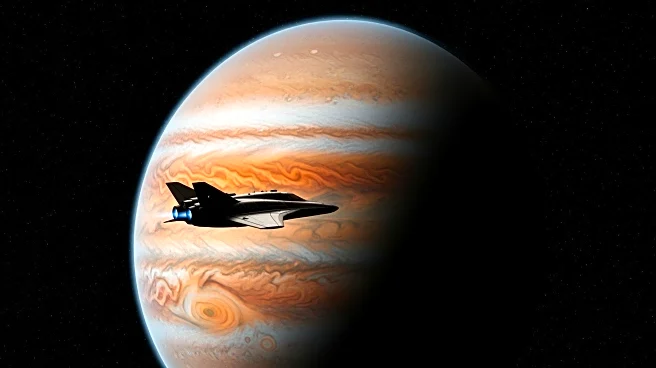




Pioneer 10's mission to Jupiter was a landmark event in space exploration, providing humanity with its first close-up images and data from the largest planet in our Solar System. This encounter marked a significant achievement for NASA and set the stage for future missions to the outer planets. This article delves into the details of Pioneer 10's historic flyby of Jupiter.
Preparing for the Flyby
Pioneer 10's journey to Jupiter began with its launch on March 3, 1972. The spacecraft was equipped with a suite of scientific instruments designed to study Jupiter's atmosphere, magnetic field, and radiation environment. As Pioneer 10 approached the gas giant, it began photographing the planet from a distance of 25 million kilometers on November 6, 1973.In preparation for the flyby, a series of 16,000 commands were uploaded to the spacecraft
to control its operations during the encounter. These commands ensured that Pioneer 10's instruments were correctly oriented and ready to capture data as it passed by Jupiter. The spacecraft's trajectory was carefully planned to maximize the information returned about the planet's radiation environment, even at the risk of potential damage to some systems.
The Closest Approach
On December 3, 1973, Pioneer 10 made its closest approach to Jupiter, coming within 132,252 kilometers of the planet's outer atmosphere. During this time, the spacecraft's instruments were used to study the planet's magnetic field, radiation belts, and atmosphere. Pioneer 10 confirmed that Jupiter's magnetic field was inverted compared to Earth's and provided valuable data on the planet's intense radiation environment.The spacecraft's imaging system captured over 500 images of Jupiter and its moons, including Ganymede and Europa. These images revealed details of the planet's atmosphere, including the Great Red Spot, and provided the first close-up views of its moons. Despite the intense radiation, which was ten times stronger than anticipated, Pioneer 10's instruments continued to function, allowing it to send back valuable data to Earth.
Legacy of the Jupiter Encounter
Pioneer 10's encounter with Jupiter was a groundbreaking achievement that paved the way for future missions to the outer planets. The data collected during the flyby provided new insights into Jupiter's atmosphere, magnetic field, and radiation environment, which were crucial for the planning of subsequent missions, such as the Voyager probes.The success of Pioneer 10's mission demonstrated the feasibility of sending spacecraft to the outer Solar System and highlighted the importance of careful planning and engineering in overcoming the challenges of deep-space exploration. Pioneer 10's encounter with Jupiter remains a testament to human ingenuity and the spirit of exploration.