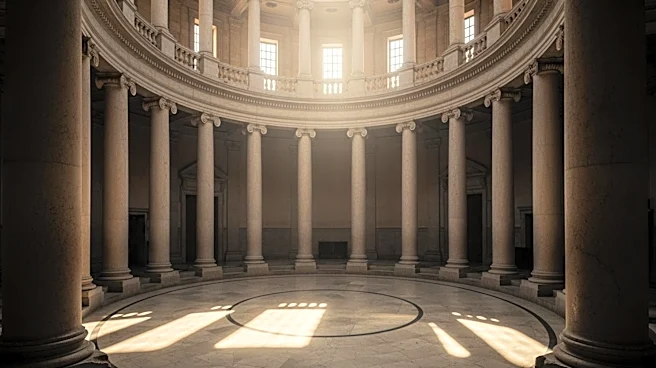




The United States Capitol crypt is a fascinating architectural feature located beneath the Capitol rotunda in Washington, D.C. This large circular room, filled with forty neoclassical Doric columns, was originally built to support the rotunda and provide an entrance to Washington's Tomb. Today, it serves as a museum and houses thirteen statues from the National Statuary Hall Collection. The crypt's design and construction reflect the neoclassical style
that characterizes much of the Capitol building.
Origin and Construction
The concept of the crypt originated with the initial designs for the United States Capitol by William Thornton. Thornton's plans included a rotunda positioned between the two wings of the building, necessitating a supporting structure beneath it. Construction of the Capitol began in 1793, with George Washington laying the cornerstone for the north wing. However, the central section, including the rotunda and crypt, did not commence until after the War of 1812.
The crypt was intended to serve as the entry to Washington's Tomb, a plan that was approved by Martha Washington following George Washington's death in 1799. Despite this approval, construction faced significant delays, particularly due to the War of 1812. The British capture of Washington in 1814 resulted in the Capitol being set ablaze, halting construction efforts. It wasn't until 1827, under Architect of the Capitol Charles Bulfinch, that the central section was completed.
Design Features
The crypt is notable for its neoclassical design, featuring forty Doric columns that support the rotunda above. This architectural style is consistent with the overall design of the Capitol, which is renowned for its neoclassical elements. A marble compass set into the floor marks the point where the four quadrants of the District of Columbia meet, adding a unique geographical significance to the crypt.
The crypt's design was influenced by the need to support the large rotunda above, a central feature of the Capitol. The use of Doric columns not only provides structural support but also contributes to the aesthetic appeal of the space. The crypt's design reflects the architectural trends of the period, emphasizing symmetry, proportion, and the use of classical elements.
Current Usage
Today, the Capitol crypt serves as a museum and a key stop on Capitol tours provided through the Capitol Visitor Center. It houses thirteen statues from the National Statuary Hall Collection, representing the original thirteen states. The crypt also contains the Magna Carta Case, which held a copy of the Magna Carta during the Bicentennial celebration.
The crypt's role as a museum and repository for statues highlights its continued importance within the Capitol complex. It serves as a historical and cultural touchstone, offering visitors a glimpse into the architectural and political history of the United States. Despite its original purpose as an entry to Washington's Tomb, the crypt has evolved into a space that celebrates the nation's heritage and architectural achievements.