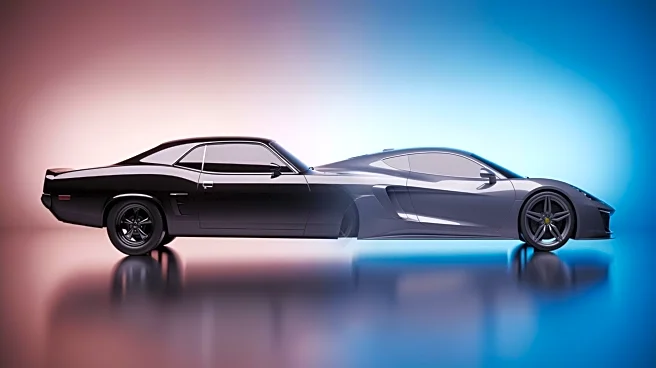

The Dodge Challenger has been a staple in the muscle car world since its inception. Over the years, it has undergone significant transformations, each generation bringing something new to the table. From its early days as a pony car to its modern incarnation as a full-size muscle car, the Challenger has evolved while maintaining its core identity. This article delves into the three distinct generations of the Dodge Challenger, highlighting their unique
features and the changes they brought to the automotive landscape.
First Generation: The Pony Car Era
The first generation of the Dodge Challenger was introduced in the autumn of 1969 for the 1970 model year. Built on the Chrysler E platform, it shared many components with the Plymouth Barracuda. This generation was designed to compete in the upper end of the pony car market, going head-to-head with the Mercury Cougar and Pontiac Firebird. Despite its premium price, the Challenger was intended to be the most potent pony car ever, offering a wide variety of trim and option levels, including the famed 426 Hemi engine.
The design of the first-generation Challenger was the work of Carl Cameron, who also designed the 1966 Dodge Charger. The Challenger's longer wheelbase and larger dimensions set it apart from its competitors, offering a more luxurious interior. However, the pony car segment was already in decline by the time the Challenger arrived, and while initial sales were strong, they fell dramatically after 1970. Production ceased midway through the 1974 model year, with a total of 165,437 units sold.
Second Generation: A Shift in Identity
The second generation of the Dodge Challenger, produced from 1978 to 1983, marked a significant departure from its predecessor. This iteration was a rebadged Mitsubishi Galant Lambda/Sapporo, a coupe version of an economical compact car. Unlike the first generation, the second-generation Challenger was not a muscle car but rather a compact coupe with smaller engines.
This generation retained the frameless hardtop styling of the original Challenger but featured smaller engines, including a 1.6 L inline-four and a 2.6 L inline-four. These engines were rated at power outputs of 77 to 105 hp. Despite its departure from the muscle car image, the second-generation Challenger offered increased foot room, headroom, trunk capacity, and soundproofing, catering to a different market segment.
Third Generation: The Return of the Muscle Car
The third and most recent generation of the Dodge Challenger was introduced in early 2008. This full-size muscle car was designed to rival the evolved fifth-generation Ford Mustang and the fifth-generation Chevrolet Camaro. The third-generation Challenger brought back the muscle car ethos, with powerful engine options and a design that paid homage to the original 1970 Challenger R/T.
In November 2021, Stellantis announced that the 2023 model year would be the final one for the Dodge Challenger, as the company shifted its focus to electric vehicles. Production ended on December 22, 2023, marking the end of an era for the iconic muscle car. Despite its discontinuation, the Dodge Challenger remains a symbol of American automotive history, celebrated for its performance and enduring legacy.