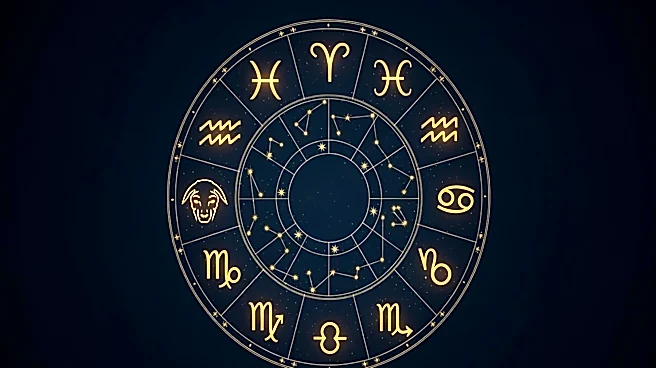

The zodiac, a celestial coordinate system, has a rich history that dates back thousands of years. Originating in Babylonian astronomy, the zodiac has evolved through various cultures and eras, influencing
both astrology and astronomy. This article delves into the historical development of the zodiac, tracing its journey from ancient Babylon to its modern interpretations.
Babylonian Beginnings
The zodiac's origins can be traced back to Babylonian astronomy during the first millennium BC. Babylonian astronomers divided the ecliptic into twelve equal parts, each corresponding to a zodiac sign. This division was based on earlier star catalogs, such as the MUL.APIN, which was compiled around 1000 BC. The Babylonians used these divisions to create the first known celestial coordinate system, which allowed them to make predictions about planetary positions.
Around the end of the fifth century BC, the Babylonians further refined the zodiac by dividing it into twelve equal signs, each containing 30 degrees of celestial longitude. This system was likely introduced during Persian rule, between 409 and 398 BC. Unlike modern astrologers, who align the zodiac with the vernal equinox, Babylonian astronomers fixed the zodiac in relation to stars, marking the beginning of Cancer at the "Rear Twin Star" and Aquarius at the "Rear Star of the Goat-Fish."
Greek and Roman Influence
The Babylonian zodiac was introduced to Greek astronomy in the 4th century BC, significantly influencing Hellenistic astrology. Greek astronomers, such as Eudoxus of Cnidus, adopted the Babylonian star catalogs, and the zodiac became synonymous with "Chaldean wisdom" among Greeks and Romans. The Dendera zodiac, dating to around 50 BC, is the first known depiction of the classical zodiac of twelve signs.
Ptolemy, a prominent Greek astronomer and astrologer, played a crucial role in the development of Western horoscopic astrology. His work, the Tetrabiblos, laid the foundation for the Western astrological tradition, rationalizing the planets, Houses, and zodiac signs. Ptolemy's influence was so profound that his explanations of the tropical zodiac, aligned with the equinoxes and solstices, remain largely unchanged today.
The Zodiac in Modern Times
In modern astronomy, the zodiac continues to serve as a celestial coordinate system, used for tracking solar system objects. The zodiac defines a belt of space extending 8 to 9 degrees in celestial latitude north and south of the ecliptic. This narrow band is due to the slight inclination of most planets' orbits relative to Earth's orbital plane.
The zodiac's influence extends beyond astronomy, as it remains a central element in astrology. Despite the precession of the equinoxes, which has shifted the zodiac signs' alignment with the constellations, the zodiac continues to captivate people's imaginations. Its historical journey from ancient Babylon to modern times highlights its enduring significance in both scientific and cultural contexts.