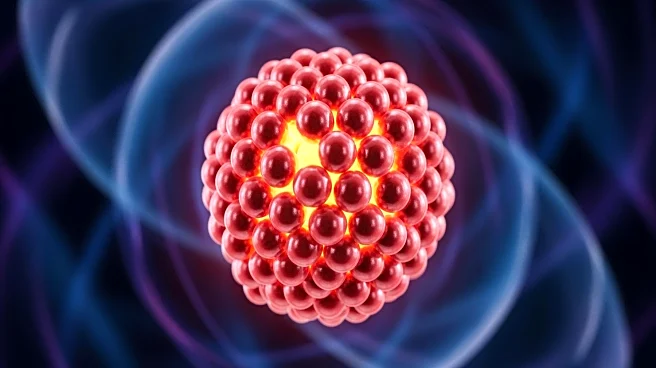




Protons are one of the most fundamental components of matter, playing a critical role in the composition of the universe. As stable subatomic particles with a positive charge, protons are found in the nucleus of every atom and are essential in forming the building blocks of matter. This article explores the significance of protons in the universe, their role in atomic nuclei, and their contribution to the formation of elements.
Protons in Atomic Nuclei
Protons, along with
neutrons, are the primary constituents of atomic nuclei. Together, they are referred to as nucleons. The presence of protons in the nucleus is crucial for the stability of atoms, as they provide the positive charge that attracts electrons, forming a balanced atomic structure. The number of protons in the nucleus, known as the atomic number, is a defining characteristic of each element and determines its position in the periodic table.
The strong nuclear force binds protons and neutrons together in the nucleus, overcoming the electrostatic repulsion between the positively charged protons. This force is one of the fundamental interactions in nature and is essential for the stability of atomic nuclei. Without protons, the structure of atoms would not exist, and the universe as we know it would be vastly different.
Formation of Elements
Protons play a pivotal role in the formation of elements through nuclear reactions. In the early universe, during the process known as nucleosynthesis, protons combined with neutrons to form the first atomic nuclei. This process led to the creation of the lightest elements, such as hydrogen and helium, which are the most abundant elements in the universe.
In stars, protons are involved in nuclear fusion reactions, where they combine to form heavier elements. For example, in the core of the sun, protons fuse to form helium through a series of reactions known as the proton-proton chain. This fusion process releases a tremendous amount of energy, which powers the sun and other stars. The formation of heavier elements through fusion in stars is a fundamental process that contributes to the diversity of elements found in the universe.
Protons in Cosmic Rays
Protons are also a significant component of cosmic rays, which are high-energy particles that travel through space. These protons originate from various sources, including the sun and distant galaxies. When cosmic rays interact with the Earth's atmosphere, they can produce secondary particles, contributing to the background radiation on Earth.
The study of cosmic rays provides valuable insights into the processes occurring in the universe, such as the behavior of high-energy particles and the conditions in distant astrophysical environments. Protons, as a major component of cosmic rays, play a crucial role in these studies, helping scientists understand the fundamental nature of the universe.
In summary, protons are essential building blocks of the universe, forming the core of atomic nuclei and contributing to the formation of elements. Their role in nuclear reactions and cosmic rays highlights their significance in the composition and behavior of matter in the universe. As fundamental components of matter, protons continue to be a focus of scientific research, providing insights into the nature of the universe.