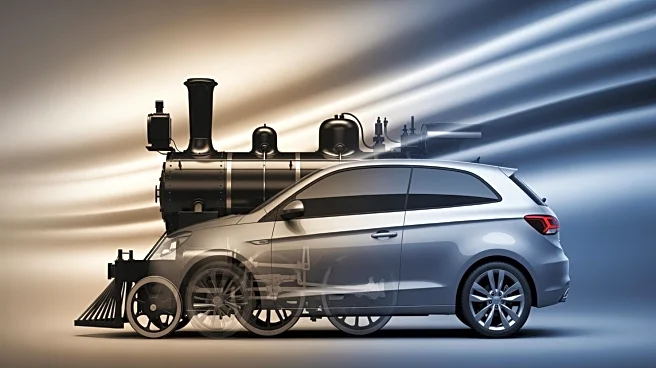



Daihatsu Motor Co., Ltd. is a Japanese automobile manufacturer with a rich history that dates back to the early 20th century. Known for its focus on compact cars, Daihatsu has evolved significantly over the years, transitioning from steam engines to becoming a key player in the automotive industry. This article explores the historical development of Daihatsu, highlighting its journey from its origins to its current status as a subsidiary of Toyota
Motor Corporation.
Early Beginnings and Steam Engines
Daihatsu's roots can be traced back to 1907 when it was founded as Hatsudoki Seizo Co., Ltd. The company initially focused on developing gasoline-powered engines for small, stationary power plants. This early focus on engine development was largely influenced by the Engineering Department's faculty of Osaka University. During its formative years, Daihatsu concentrated on steam engines for Japanese National Railways, including rail carriages for passenger transportation.
By the 1930s, Daihatsu began to shift its focus towards automobile production. This transition was influenced by the growing automobile manufacturing industry in Japan, with companies like Ford and General Motors establishing factories in the country. Daihatsu's decision to enter the automotive sector marked a significant turning point in its history, setting the stage for its future success.
Transition to Automobile Manufacturing
In 1951, Daihatsu officially became Daihatsu Motor Co., Ltd., succeeding Hatsudoki Seizo Co., Ltd. This change was part of a major restructuring effort that aimed to position the company as a leading automobile manufacturer. During the 1960s, Daihatsu began exporting its vehicles to Europe, although it did not achieve major sales success until the 1980s.
Daihatsu's focus on compact cars became more pronounced during this period, with the majority of its models occupying the kei car segment in Japan. The company's expertise in producing small, efficient vehicles allowed it to carve out a niche in the automotive market, catering to consumers seeking affordable and practical transportation solutions.
Modern-Day Focus and Toyota Partnership
Daihatsu's relationship with Toyota Motor Corporation began in 1967 when Toyota became a major shareholder. This partnership was further solidified in 1998 when Toyota acquired a controlling interest in Daihatsu, eventually making it a wholly-owned subsidiary in 2016. As part of the Toyota Group, Daihatsu continues to focus on producing entry-level compact cars for Japan and Southeast Asia.
Today, Daihatsu is known for its range of kei car models, along with kei trucks and vans. The company's commitment to innovation and quality has allowed it to maintain a strong presence in the automotive industry, with its vehicles often supplied to global emerging markets under the Toyota brand.