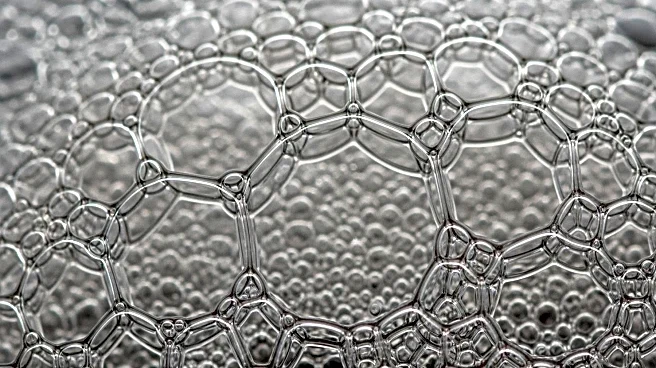




Foam is a fascinating material that plays a significant role in various industries and everyday life. It is a two-phase system where gas is dispersed in a liquid or solid matrix, creating a structure that is both lightweight and versatile. This article delves into the scales and properties of foam, focusing on aspects such as drainage, osmotic pressure, and gas diffusion, which are crucial for understanding its behavior and applications.
The Role of Drainage in Foam Stability
One of the
key properties of foam is its ability to maintain stability over time. Drainage is a critical factor that affects this stability. In a foam structure, liquid tends to drain from the lamellas, which are the thin films separating the gas bubbles, to the Plateau borders, the thicker regions where three or more bubbles meet. This drainage is primarily driven by gravity, causing the liquid to move downward, which can lead to the thinning and eventual rupture of the lamellas.
The rate of drainage is influenced by several factors, including the viscosity of the liquid and the size of the bubbles. Smaller bubbles tend to have a slower drainage rate due to the higher surface tension forces acting on them. Understanding the dynamics of drainage is essential for applications where foam stability is crucial, such as in firefighting foams and food products.
Osmotic Pressure and Gas Diffusion in Foam
Osmotic pressure and gas diffusion are two other important properties that influence foam behavior. Osmotic pressure arises from concentration differences within the foam, causing liquid to move from areas of lower concentration to higher concentration. This movement can lead to changes in the foam structure, affecting its stability and lifespan.
Gas diffusion, on the other hand, involves the movement of gas molecules from smaller to larger bubbles due to pressure differences, a phenomenon known as the Laplace pressure. This process can cause smaller bubbles to shrink and larger bubbles to grow, leading to coarsening of the foam over time. Both osmotic pressure and gas diffusion are critical in determining the longevity and performance of foam in various applications.
The Impact of Foam Properties on Applications
The unique properties of foam make it suitable for a wide range of applications, from cushioning materials in furniture to insulation in buildings. The ability to control drainage, osmotic pressure, and gas diffusion allows manufacturers to tailor foam properties to specific needs. For instance, in the food industry, controlling these properties can enhance the texture and stability of products like whipped cream and meringues.
In industrial applications, understanding foam properties is essential for optimizing processes such as froth flotation in mineral processing and foam fractionation in chemical engineering. By manipulating the scales and properties of foam, industries can improve efficiency and product quality, highlighting the importance of continued research and development in this field.