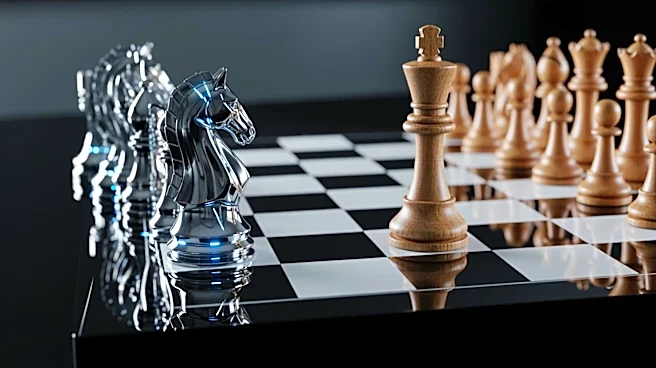








The chess matches between IBM's supercomputer Deep Blue and world champion Garry Kasparov in 1996 and 1997 marked a significant milestone in the history of artificial intelligence and chess. These matches were not only a test of human versus machine but also a demonstration of the rapid advancements in computer technology. The outcomes of these matches had a profound impact on the perception of artificial intelligence and its capabilities.
The 1996 Match: A New Challenger
In 1996,
Garry Kasparov faced off against Deep Blue in a six-game match held in Philadelphia. This was the first time a reigning world chess champion played against a computer under standard tournament conditions. Deep Blue, developed by IBM, was a formidable opponent, capable of evaluating millions of positions per second. The match began with a surprising victory for Deep Blue in the first game, marking the first time a computer defeated a world champion in a classical game.
Despite this initial setback, Kasparov demonstrated his superior strategic skills by winning three of the remaining five games and drawing two, ultimately winning the match 4-2. This victory reinforced the belief that while computers were powerful, human intuition and strategic thinking still held the upper hand in chess.
The 1997 Rematch: A Turning Point
The rematch in 1997, held in New York City, was a different story. Deep Blue had been upgraded and was now capable of evaluating even more positions per second. The match was closely contested, with Kasparov winning the first game and Deep Blue taking the second. The next three games ended in draws, setting the stage for a decisive final game.
In the sixth game, Deep Blue played aggressively, and Kasparov, perhaps underestimating the computer's capabilities, made a series of errors. Deep Blue won the game, and with it, the match, by a score of 3½–2½. This victory was historic, as it was the first time a computer had defeated a reigning world champion in a full match under tournament conditions.
The Aftermath and Legacy
The 1997 match had a lasting impact on the world of chess and artificial intelligence. It demonstrated that computers could not only compete with but also defeat the best human players. This victory was seen as a symbolic moment, highlighting the potential of artificial intelligence to tackle complex problems.
Kasparov's loss sparked debates about the role of computers in chess and the future of human-computer interactions. While some viewed it as a triumph of technology, others saw it as a challenge to human intellect. Regardless, the matches between Deep Blue and Kasparov remain a pivotal moment in the history of both chess and artificial intelligence.