





Dictionaries have been an essential tool for understanding and translating languages throughout history. From ancient bilingual wordlists to modern digital databases, dictionaries have evolved significantly over the centuries. This article explores the historical development of dictionaries, highlighting key milestones and changes in their form and function.
Ancient Beginnings
The earliest known dictionaries date back to around 2300 BCE, originating as bilingual Sumerian-Akkadian
wordlists. These were discovered in Ebla, modern-day Syria, and served as a crucial resource during the Akkadian Empire. The Urra=hubullu glossary from the early 2nd millennium BCE is another example, representing the canonical Babylonian version of these bilingual lists.
In China, the Erya, compiled around the 3rd century BCE, is recognized as the earliest surviving monolingual dictionary. Although some sources suggest the Shizhoupian as an earlier dictionary, modern scholarship views it as a compendium of Chinese characters rather than a true dictionary.
Medieval and Renaissance Developments
The medieval period saw the creation of dictionaries in various languages, including Sanskrit, Arabic, and Japanese. The Amarakoṣa, a Sanskrit dictionary written by Amarasimha in the 4th century CE, listed around 10,000 words in verse form. In the 8th century, Al-Khalil ibn Ahmad al-Farahidi compiled the Kitab al-'Ayn, the first dictionary of Arabic.
In Europe, the first purely English alphabetical dictionary, A Table Alphabeticall, was published in 1604 by Robert Cawdrey. This marked a significant shift towards monolingual dictionaries in the region. The systematic study of dictionaries, known as lexicography, emerged as a scientific discipline in the 20th century, largely initiated by Ladislav Zgusta.
Modern Innovations
The 20th century brought about significant changes in dictionary compilation and usage. The Oxford English Dictionary (OED), first published in 1884, remains a principal historical dictionary of the English language. It traces the development of English and provides comprehensive descriptions of its usage worldwide.
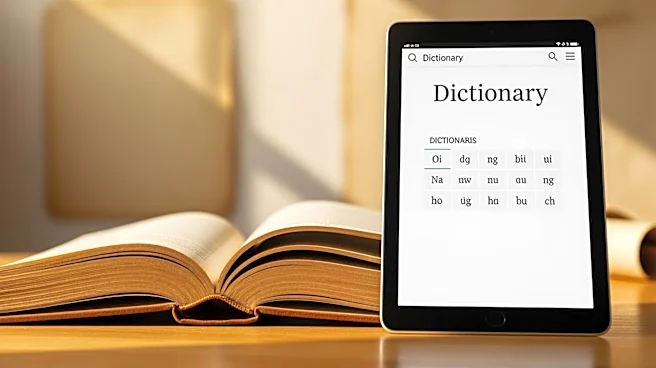
Digital technology has revolutionized dictionaries, making them more accessible and interactive. Online dictionaries like Wiktionary offer extensive definitions across multiple languages, surpassing traditional print dictionaries in scope and convenience. The OED itself has transitioned to an online format, continuously updated to reflect changes in language use.
Dictionaries have come a long way from their ancient origins, adapting to the needs of language users across different eras. As language continues to evolve, dictionaries will undoubtedly continue to play a vital role in communication and understanding.