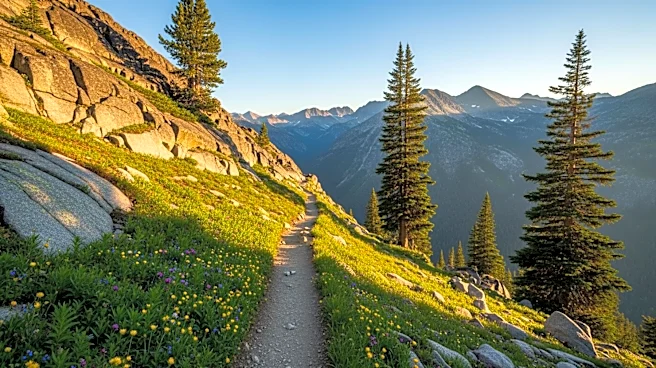

The John Muir Trail, a celebrated hiking path in California's Sierra Nevada, has a rich history that dates back to the late 19th century. Named in honor of John Muir, a prominent naturalist and advocate
for wilderness preservation, the trail was conceived as a way to connect the stunning landscapes of the High Sierra. Its development involved decades of exploration, advocacy, and construction, culminating in a trail that is now a beloved destination for outdoor enthusiasts.
Origins and Early Advocacy
The idea for the John Muir Trail originated with Theodore Solomons, who envisioned a trail along the crest of the Sierra Nevada. Solomons began advocating for the trail shortly after the Sierra Club was founded in 1892, with John Muir as its first president. Solomons explored potential routes, laying the groundwork for what would become the JMT.
Joseph Nisbet LeConte later took up the cause, spending years exploring the canyons and passes of the Kings River and Kern River. Along with fellow adventurers, LeConte pioneered a high mountain route from Yosemite National Park to Kings Canyon, roughly along the modern JMT's path. Their efforts were instrumental in promoting the idea of a continuous trail through the Sierra Nevada.
Construction and Completion
Construction of the John Muir Trail began in 1915, a year after John Muir's death. The California legislature provided initial funding, and State Engineer Wilbur F. McClure oversaw the project. The United States Forest Service and the National Park Service played crucial roles in the trail's construction, with LeConte influencing the final route.
The trail's completion was a lengthy process, with challenging sections requiring significant effort. The connection from the Kings River to the Kern River over Forester Pass was completed in 1932, involving dangerous work that led to the death of a trail crew member. The final section at Palisade Creek was finished in 1938, marking the end of a 46-year endeavor.
Legacy and Recognition
The John Muir Trail stands as a fitting tribute to its namesake, who spent many years exploring the Sierra Nevada. The trail's creation was a collaborative effort, reflecting the dedication of those who sought to preserve and celebrate the region's natural beauty. The California Wilderness Act of 1984 further solidified the trail's legacy by merging the John Muir Wilderness and the Ansel Adams Wilderness.
Today, the JMT is recognized as one of the premier hiking trails in the United States, attracting thousands of hikers each year. Its historical significance and stunning landscapes continue to inspire adventurers and conservationists alike, ensuring that John Muir's vision of wilderness appreciation lives on.