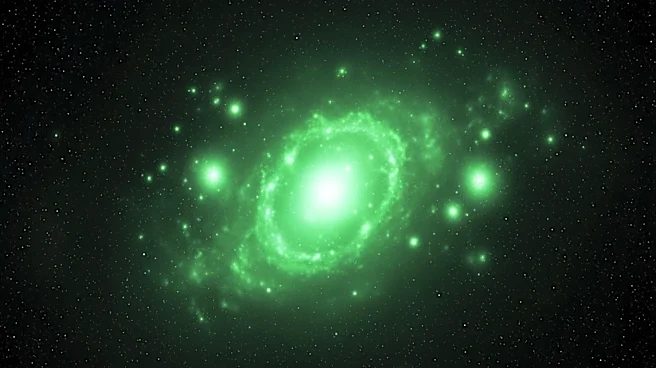







Green Bean Galaxies (GBGs) are a fascinating and rare type of astronomical object that have captured the interest of astronomers due to their unique properties. These galaxies are thought to be quasar ionization echoes, a phenomenon that provides insight into the life cycle of quasars. Discovered by Mischa Schirmer and colleagues, GBGs are characterized by their ultra-luminous narrow-line regions and are found at specific redshifts.
Discovery and Initial Observations
The discovery of
Green Bean Galaxies was made by Mischa Schirmer and his team, including R. Diaz, K. Holhjem, N.A. Levenson, and C. Winge. While examining survey images taken with the Canada–France–Hawaii Telescope, Schirmer noticed a galaxy with unusual colors, strongly peaking in the r filter, which suggested a spectral line. This observation led to the identification of GBGs, which are similar in color to Green Pea galaxies but are significantly larger.
GBGs are extremely rare, with only one typically found in a cube about 1.3 billion light-years across. Their rarity suggests that the phenomenon is either very short-lived or uncommon. The interstellar gas in GBGs is ionized by hard x-rays from an active galactic nucleus, unlike the UV-light ionization seen in Green Pea galaxies.
Defining Features and Rarity
Green Bean Galaxies are notable for their ultra-luminous narrow-line regions, which are galaxy-wide. These regions are observed at redshifts between 0.2 and 0.6. The luminosity, size, and gas mass of GBGs are significantly higher than those of other quasar ionization clouds, such as the 'voorwerpjes' studied by Keel et al. in 2012.
The GBGs are thought to be related to Hanny's Voorwerp, another possible quasar ionization echo. However, GBGs differ in their scale and brightness, providing a unique fossil record of the transformation from the most luminous quasars to weak active galactic nuclei.
Implications for Quasar Life Cycles
The study of Green Bean Galaxies offers valuable insights into the life cycle of quasars. The ionization echoes observed in GBGs are believed to be remnants of a recent high activity episode of a quasar. This suggests that GBGs are witnessing the aftermath of a quasar's active phase, providing a snapshot of the transition from a super-luminous quasar to a less active state.
The escaping X-rays from the former active quasar state continue to ionize the gas, creating the ionization echo. This phenomenon highlights the role of AGN feedback in the rapid shutdown of quasar activity, offering a glimpse into the dynamic processes that govern the evolution of galaxies and their central black holes.