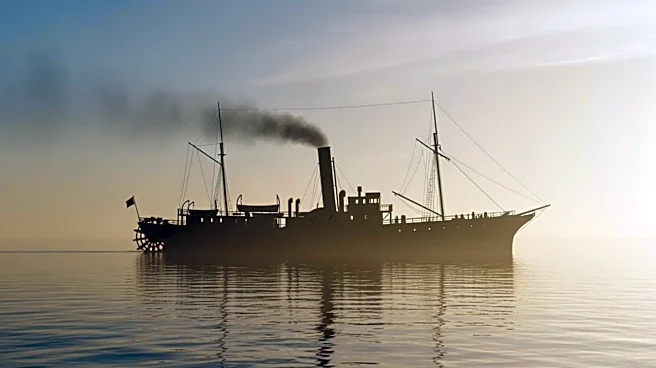




The SS Savannah holds a special place in maritime history as the first steamship to cross the Atlantic Ocean. Built in 1818, this American hybrid sailing ship and sidewheel steamer embarked on its historic journey in 1819, marking a significant milestone in the evolution of sea travel. Despite its groundbreaking achievement, the SS Savannah faced challenges that prevented it from becoming a commercial success. This article delves into the details
of its pioneering voyage and the impact it had on future steamship travel.
The Construction and Design of the SS Savannah
The SS Savannah was constructed at the New York shipyard of Fickett & Crockett, initially laid down as a sailing packet. However, Captain Moses Rogers, with financial backing from the Savannah Steam Ship Company, purchased the vessel to convert it into an auxiliary steamship. The ship was fitted with an auxiliary steam engine and paddlewheels in addition to its sails, making it a hybrid vessel. The engine and machinery were notably large for the time, with a 90-horsepower low-pressure engine and 16-foot diameter paddlewheels.
The design of the SS Savannah was unique, with its hull and rigging constructed under the direction of Captain Stevens Rogers. The ship was full-rigged like a normal sailing ship, but with modifications to accommodate the engine and boiler. The paddlewheels were retractable, a feature that allowed them to be folded up and stored on deck when not in use, reducing drag and avoiding damage.
The Historic Transatlantic Crossing
The SS Savannah set sail from Savannah Harbor on May 22, 1819, bound for Liverpool, England. The voyage commenced under both steam and sail, with the ship relying primarily on its sails. The journey was not without its challenges; the ship ran out of fuel for its engine off the coast of Ireland and had to rely solely on sail power. Despite these difficulties, the SS Savannah arrived in Liverpool on June 20, 1819, greeted by hundreds of boats and a cheering crowd.
During the voyage, the SS Savannah encountered several other vessels, including the British cutter HMS Kite, which mistook the steamship for a vessel on fire. The crossing took 29 days and 11 hours, with the engine employed for a total of 80 hours. This historic journey demonstrated the potential of steam power for transatlantic travel, even though the ship primarily used sail power.
The Legacy of the SS Savannah
Despite its successful crossing, the SS Savannah did not achieve commercial success. The large engine and fuel requirements limited its cargo capacity, and public skepticism about steam power further hindered its viability. After returning to the United States, the ship was converted back into a sailing vessel and eventually wrecked off Long Island in 1821.
The SS Savannah's voyage proved that steamships could cross the ocean, paving the way for future developments in steam-powered travel. However, it would be nearly 30 years before another American-owned steamship would make a transatlantic crossing. The SS Savannah's legacy lives on as a testament to the innovation and ambition of early steamship pioneers.