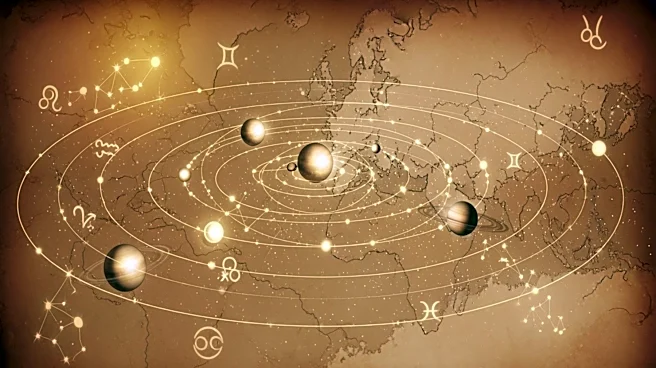







The concept of classical planets has been a cornerstone of ancient astronomy, shaping the way early civilizations understood the cosmos. These celestial bodies, visible to the naked eye, were considered wandering stars and held significant importance in various cultures. The classical planets include the Sun, Moon, Mercury, Venus, Mars, Jupiter, and Saturn, each with its unique characteristics and influence.
Ancient Observations and Naming
In ancient times, the classical planets
were observed and recorded by various civilizations, including the Babylonians and Greeks. The Babylonians recognized seven planets, each associated with a deity, such as the Moon with Sin and the Sun with Shamash. This association with deities reflected the planets' perceived influence on human affairs and natural phenomena.
Greek astronomers, like Geminus and Ptolemy, further developed the understanding of these planets. They introduced the term 'planet,' meaning 'wanderer' in Greek, to describe their movement across the sky relative to the fixed stars. This movement was a source of fascination and study, leading to the development of early astrological theories.
The Role of Classical Planets in Astrology
Astrology, a practice deeply intertwined with astronomy, attributed specific characteristics to each classical planet. These attributes were believed to influence human behavior and destiny. For instance, Mars was associated with war and aggression, while Venus symbolized love and beauty.
The astrological symbols for these planets, preserved in medieval Byzantine codices, reflect their significance in ancient horoscopes. These symbols were used to represent the gods associated with the planets, further cementing their role in astrological practices.
Transition to Modern Understanding
The understanding of classical planets evolved with the advent of telescopes and the discovery of new celestial bodies. The definition of a planet shifted from a wandering star to a natural satellite orbiting the Sun. This reclassification led to the recognition of only five of the original seven classical planets as true planets, alongside Earth, Uranus, and Neptune.
Despite these changes, the classical planets continue to hold cultural and historical significance. They represent humanity's early attempts to make sense of the universe and our place within it. The study of these planets laid the groundwork for modern astronomy and astrology, bridging the gap between ancient beliefs and contemporary science.