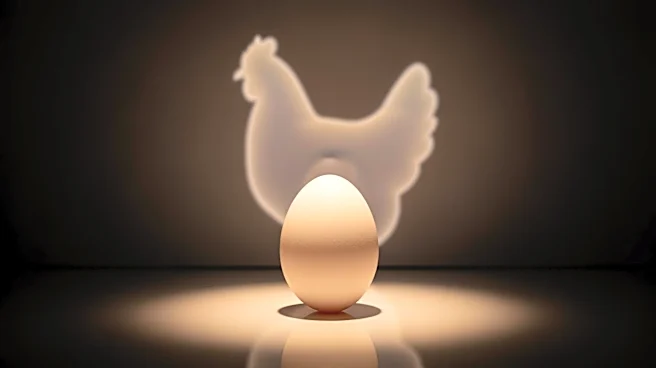


The age-old question of "which came first: the chicken or the egg?" has puzzled thinkers for centuries. This dilemma is not just a simple query about poultry but a profound philosophical paradox that challenges our understanding of causality and origins. The question has been posed by philosophers like Plutarch and Aristotle, and it continues to be a topic of debate and reflection.
Historical Roots of the Dilemma
The chicken or the egg dilemma has ancient origins, with philosophers
like Plutarch addressing it as early as the 1st century CE. Plutarch considered the question in his essay "The Symposiacs," pondering whether the world had a beginning. This reflects the broader philosophical inquiry into the nature of existence and the origins of life. Aristotle, writing in the fourth century BCE, viewed the dilemma as an infinite sequence with no true origin, suggesting that causality itself might be an endless loop.
By the end of the 16th century, the question seemed settled in the Christian world, where the biblical creation story provided an answer: the chicken came first, created by divine intervention. However, Enlightenment philosophers later questioned this solution, seeking more empirical explanations. The dilemma thus serves as a metaphor for the challenges of understanding causality and the sequence of events.
Scientific Perspectives on the Dilemma
While the chicken or the egg question is often used metaphorically, evolutionary biology offers literal answers. According to Darwinian principles, species evolve over time, meaning chickens had ancestors that were not chickens. If the question refers to eggs in general, the egg came first, as the first amniote egg appeared around 312 million years ago, long before chickens existed.
For chicken eggs specifically, the answer remains the egg, but the explanation is complex. The modern chicken arose through interbreeding and domestication of wild jungle fowl, with a proto-chicken laying a fertilized egg that became a modern chicken due to genetic mutations. This scientific perspective highlights the arbitrary nature of defining when an evolving organism becomes a distinct species.
The Role of Proteins in the Debate
Recent scientific discoveries have added another layer to the chicken or the egg debate. The protein ovocleidin-17 (OC-17), found in modern chicken eggs, plays a crucial role in forming the eggshell. Since OC-17 is produced by the hen, not the egg, the first bird with this protein would have hatched from a non-reinforced egg, suggesting the chicken came before the first "modern" chicken egg.
However, similar proteins are found in other bird species, indicating that eggshell-reinforcing proteins predate chickens. This complicates the argument, as it suggests that the evolutionary development of eggshells is a common trait among birds, not unique to chickens. Thus, the debate continues, blending philosophical inquiry with scientific exploration.