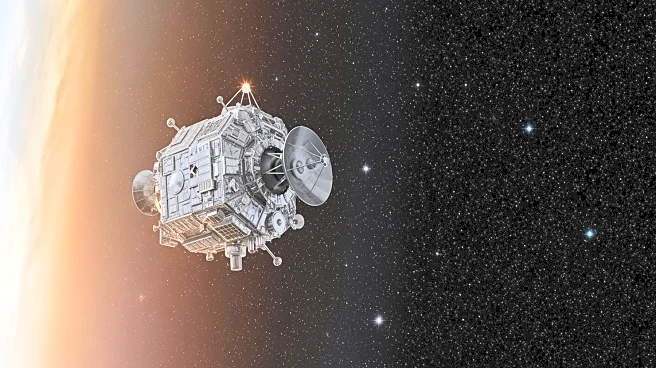

Launched by NASA in 1977, Voyager 1 has embarked on a remarkable journey through our solar system and beyond. As the farthest human-made object from Earth, it has provided invaluable data about the outer planets and the interstellar medium. This article traces the key milestones of Voyager 1's mission, from its launch to its historic entry into interstellar space.
Launch and Early Mission
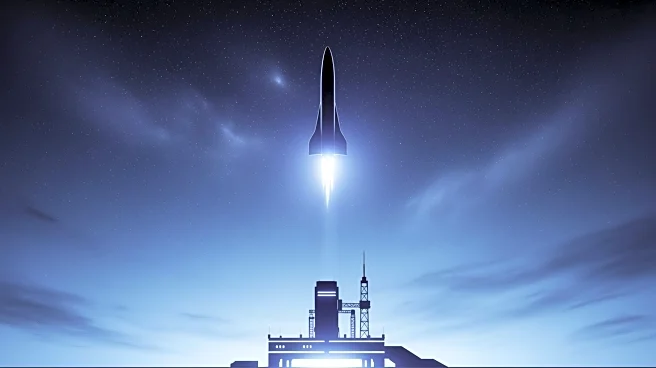
Voyager 1 was launched on September 5, 1977, from Cape Canaveral, Florida, aboard a Titan
IIIE launch vehicle. Despite being launched after its twin, Voyager 2, Voyager 1 followed a shorter trajectory, allowing it to reach its targets sooner. The mission was initially part of a grand tour to study the outer planets, but budget constraints led to a focus on flybys of Jupiter and Saturn.
The spacecraft's early mission included a flyby of Jupiter, where it began photographing the planet in January 1979. Voyager 1's closest approach to Jupiter occurred on March 5, 1979, at a distance of about 349,000 kilometers. During this time, it provided detailed observations of Jupiter's moons, rings, and magnetic fields. One of the most significant discoveries was the active volcanic activity on the moon Io, marking the first time active volcanoes were observed on another celestial body.
Saturn and the Titan Flyby
Following its successful mission at Jupiter, Voyager 1 continued to Saturn, arriving in November 1980. The spacecraft's closest approach to Saturn was on November 12, 1980, when it came within 124,000 kilometers of the planet's cloud tops. Voyager 1's instruments detected complex structures in Saturn's rings and studied the atmospheres of both Saturn and its largest moon, Titan.
The flyby of Titan was a critical part of Voyager 1's mission. Titan was known to have a substantial atmosphere, and the spacecraft's observations were designed to maximize data collection. Voyager 1 passed behind Titan as seen from Earth, allowing scientists to measure the atmosphere's composition, density, and pressure. Although the thick haze prevented visual observation of Titan's surface, the data suggested the possibility of lakes of liquid hydrocarbons.
Entering Interstellar Space
After its encounters with Jupiter and Saturn, Voyager 1's mission was extended to explore the outer heliosphere and interstellar space. On August 25, 2012, Voyager 1 crossed the heliopause, the boundary where the solar wind transitions into the interstellar medium, making it the first spacecraft to enter interstellar space.
The journey to interstellar space was marked by several key events. In 2003, scientists believed Voyager 1 had entered the termination shock, where the solar wind slows to subsonic speeds. By 2010, the spacecraft had passed the reach of the radial outward flow of the solar wind, indicating it was in the heliosheath. Finally, in 2012, the detection of charged particles from interstellar space confirmed its entry into the interstellar medium.
Voyager 1 continues to send data back to Earth, providing insights into the interstellar environment. Its mission is expected to continue until at least 2025, as its radioisotope thermoelectric generators supply power to its instruments. As it travels further into space, Voyager 1 remains a testament to human ingenuity and the quest for knowledge beyond our solar system.