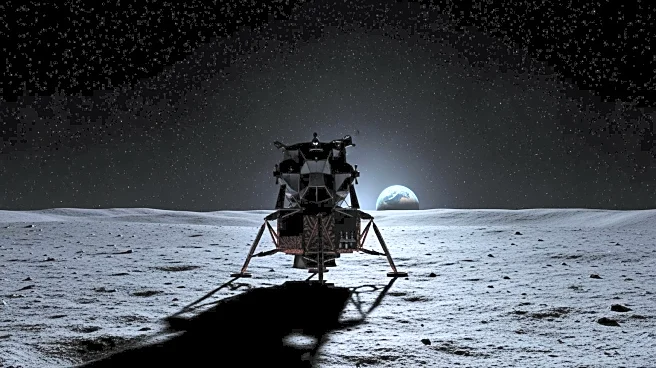




The Apollo 11 mission stands as one of the most significant achievements in human history, marking the first time humans set foot on the Moon. Launched on July 16, 1969, this mission was the culmination of years of scientific and engineering efforts by NASA and fulfilled President John F. Kennedy's ambitious goal set in 1961. The mission not only demonstrated technological prowess but also symbolized a victory in the Space Race against the Soviet
Union.
Launch and Journey to the Moon
Apollo 11 was launched from Kennedy Space Center in Florida, propelled by the powerful Saturn V rocket. The spacecraft consisted of three parts: the command module Columbia, the service module, and the lunar module Eagle. After entering Earth orbit, the crew performed a trans-lunar injection, setting them on a trajectory toward the Moon. The journey took three days, during which the astronauts conducted system checks and prepared for lunar orbit insertion.
Upon reaching the Moon's gravitational sphere, Apollo 11 executed a lunar orbit insertion burn, allowing the crew to survey potential landing sites. The Sea of Tranquility was chosen for its relatively flat terrain, minimizing landing risks. The mission's success hinged on precise calculations and the reliability of the spacecraft's systems, which had been rigorously tested in previous Apollo missions.
The Historic Moon Landing
On July 20, 1969, Neil Armstrong and Buzz Aldrin descended to the lunar surface in the Eagle. As they approached, Armstrong took manual control to avoid a boulder-strewn area, ultimately landing safely with only seconds of fuel remaining. Armstrong's first words upon stepping onto the Moon, "That's one small step for [a] man, one giant leap for mankind," were broadcast live to millions worldwide, capturing the monumental nature of the achievement.
The astronauts spent over two hours on the lunar surface, collecting samples and conducting experiments. They planted the American flag and deployed scientific instruments, including a seismometer and a retroreflector. These activities provided valuable data that would inform future lunar missions and scientific understanding.
Return to Earth and Legacy
After their lunar exploration, Armstrong and Aldrin rejoined Michael Collins in the command module, leaving the lunar module's ascent stage in orbit. The crew performed a trans-Earth injection, beginning their journey home. Apollo 11 splashed down in the Pacific Ocean on July 24, 1969, where they were recovered by the USS Hornet.
The mission's success was celebrated globally, with ticker-tape parades and accolades for the astronauts. Apollo 11 not only fulfilled Kennedy's vision but also inspired generations to pursue scientific and technological advancements. Its legacy continues to influence space exploration and remains a testament to human ingenuity and determination.