






Robert William Thomson was a Scottish inventor whose contributions to technology have had a lasting impact. Born in 1822 in Stonehaven, Scotland, Thomson was the eleventh of twelve children in a family that owned a woolen mill. Despite his family's wishes for him to enter the ministry, Thomson's interests lay elsewhere, leading him to become a self-taught inventor. His most notable inventions include the refillable fountain pen and the pneumatic tire,
both of which revolutionized their respective fields.
Early Life and Education
Robert William Thomson was born on June 29, 1822, in Stonehaven, Scotland. His early life was marked by a strong inclination towards learning and invention. Although his family hoped he would pursue a career in the ministry, Thomson's inability to master Latin led him to explore other interests. At the age of 14, he moved to Charleston, United States, to live with an uncle and apprenticed with a merchant. This experience abroad was short-lived, as he returned to Scotland two years later.
Upon his return, Thomson took a unique path by teaching himself chemistry, electricity, and astronomy. He was aided by a local weaver who had a good grasp of mathematics. This self-directed education laid the foundation for his future inventions. By the age of 17, Thomson had already rebuilt his mother's washing mangle and developed a working model of an elliptic rotary steam engine.
Inventions and Innovations
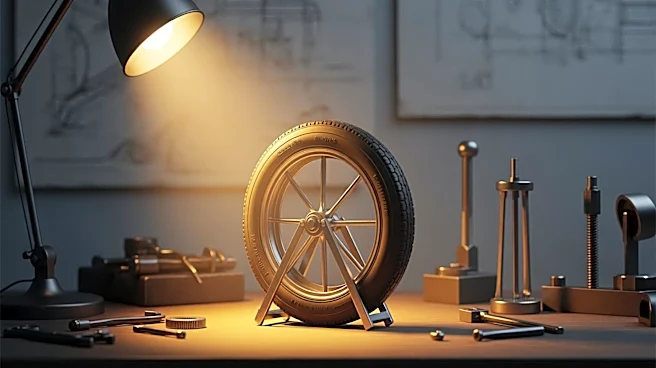
Thomson's inventive spirit led him to create several groundbreaking technologies. One of his earliest significant inventions was the pneumatic tire, which he patented in France in 1846 and in the United States in 1847. This invention consisted of a hollow belt of India-rubber inflated with air, providing a cushion of air to the ground. This innovation greatly improved the comfort and noise levels of travel, as demonstrated in London's Regent's Park in 1847.
In 1849, Thomson invented the refillable fountain pen, another significant contribution to everyday life. His work in engineering also included a new method of detonating explosive charges using electricity, which significantly reduced mining accidents worldwide. Thomson's inventions not only showcased his ingenuity but also his ability to apply scientific principles to practical problems.
Later Life and Legacy
Thomson's success as an inventor allowed him to amass considerable wealth, enabling him to live in a large townhouse in Edinburgh. He was recognized for his contributions to science and engineering, being elected a Fellow of the Royal Society of Edinburgh in 1863. From 1869 to 1871, he served as president of the Royal Scottish Society of Arts.
Thomson passed away on March 8, 1873, at the age of 50, leaving behind a legacy of innovation. His inventions, particularly the pneumatic tire, have had a lasting impact on transportation and technology. Thomson's life is a testament to the power of self-education and the impact one individual can have on the world through creativity and perseverance.