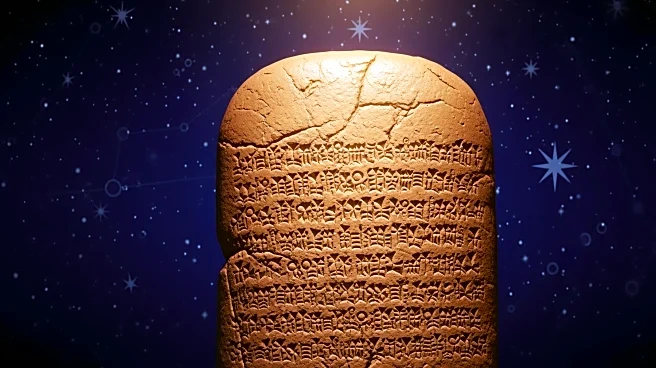




In ancient Babylonian society, celestial omens played a crucial role in shaping the decisions of rulers and the lives of ordinary people. These omens, derived from the movements and appearances of celestial bodies, were believed to be messages from the gods. The interpretation of these omens was a sophisticated practice that combined religious beliefs with early astronomical observations.
Interpreting the Will of the Gods
Babylonian priests, known as "inspectors," were tasked with
interpreting celestial omens to understand the will of the gods. This practice was deeply rooted in the belief that the gods communicated their intentions through the stars and planets. The priests developed a system of interpretation that extended from the moon, sun, and five known planets to the more prominent fixed stars.
The Enuma Anu Enlil, a collection of 70 cuneiform tablets, served as a comprehensive reference for interpreting celestial omens. This work contained thousands of omens and their associated meanings, providing a guide for priests to predict events that could impact the state and its ruler. The interpretations were based on past occurrences and associations, allowing priests to forecast future events with a degree of confidence.
Celestial Omens and State Affairs
In Babylonian society, celestial omens were primarily concerned with the welfare of the state and the king. The belief was that the king's well-being was directly linked to the fortunes of the country. As such, omens were used to guide political decisions and military strategies. For example, a lunar eclipse might be interpreted as a sign of impending danger, prompting the king to take precautionary measures.
The Babylonians also believed that evil omens could be mitigated through rituals and offerings to appease the gods. Substitute kings or events were sometimes used to divert the negative effects of an omen, reflecting the society's deep-seated belief in the power of celestial messages.
The Legacy of Babylonian Celestial Omens
The practice of interpreting celestial omens in Babylon had a lasting impact on subsequent cultures. The Babylonians' systematic approach to celestial divination laid the groundwork for later astrological systems. Their methods of associating celestial events with earthly occurrences influenced the development of astrology in the Hellenistic world and beyond.
In conclusion, celestial omens were a vital aspect of Babylonian society, influencing decisions at the highest levels of power. The priests' ability to interpret these omens was seen as a direct link to the divine, reinforcing the importance of astrology in the ancient world. The legacy of Babylonian celestial divination continues to be felt in modern astrological practices, highlighting its enduring significance.