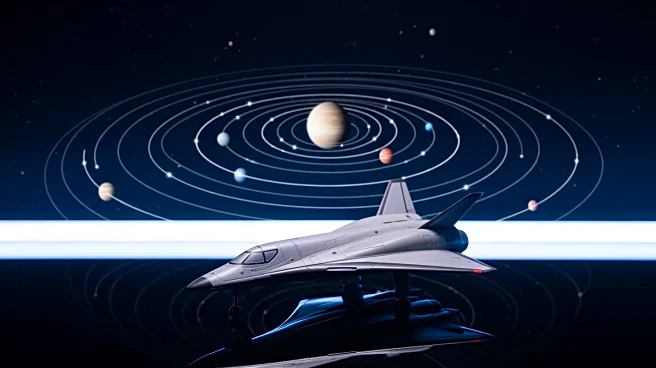



The Grand Tour program was a groundbreaking initiative by NASA aimed at exploring the outer planets of our solar system. Conceived in the 1960s, this ambitious plan sought to send robotic probes to all the outer planets, including Jupiter, Saturn, Uranus, Neptune, and Pluto. Despite its cancellation due to high costs, the program laid the groundwork for the successful Voyager missions that followed.
The Concept and Ambition
The Grand Tour program was born out of a unique planetary
alignment that occurs once every 175 years. This alignment, noted by Gary Flandro of the Jet Propulsion Laboratory in 1964, would allow a single spacecraft to visit multiple outer planets using gravity assists. The program envisioned sending two groups of robotic probes, each consisting of two spacecraft. One group would visit Jupiter, Saturn, and Pluto, while the other would target Jupiter, Uranus, and Neptune.
The program's ambitious scope was driven by the desire to conduct a comprehensive survey of the outer planets in a shorter time and at a lower cost than sending individual probes to each planet. By 1966, the Jet Propulsion Laboratory was actively promoting the project, highlighting its potential to revolutionize our understanding of the solar system.
Challenges and Cancellation
Despite its visionary goals, the Grand Tour program faced significant challenges, primarily related to its estimated cost. By 1971, the program's cost was projected to be between $750 and $900 million, with additional expenses for launching the spacecraft. This financial burden, coupled with competition from the newly approved Space Shuttle program, led to the program's cancellation in December 1971.
The cancellation of the Grand Tour program did not mark the end of NASA's exploration ambitions. Instead, it paved the way for the Mariner Jupiter-Saturn project, which eventually evolved into the Voyager program. This new initiative focused on visiting only two planets, Jupiter and Saturn, using a pair of Mariner-derived probes, significantly reducing the overall project costs.
Legacy and Impact
Although the Grand Tour program was never realized in its original form, its legacy lives on through the Voyager missions. The Voyager spacecraft, launched in 1977, successfully visited Jupiter, Saturn, Uranus, and Neptune, fulfilling many of the Grand Tour's original objectives. These missions provided invaluable data and insights into the outer planets, transforming our understanding of the solar system.
The Grand Tour program remains a testament to NASA's pioneering spirit and its commitment to exploring the unknown. Its ambitious vision and innovative approach to space exploration continue to inspire future generations of scientists and engineers, reminding us of the limitless possibilities that lie beyond our planet.