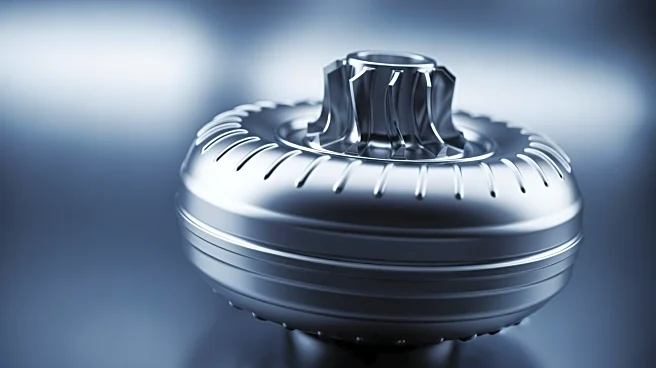




Torque converters are essential components in vehicles with automatic transmissions, playing a crucial role in transferring power from the engine to the transmission. This article delves into the mechanics of torque converters, explaining how they function and why they are vital for smooth vehicle operation. By understanding the inner workings of torque converters, drivers can appreciate the technology that allows their vehicles to perform efficiently
under various driving conditions.
The Basics of Torque Converters
A torque converter is a type of fluid coupling device that connects the engine to the transmission in vehicles with automatic transmissions. Unlike manual transmissions that use a mechanical clutch, torque converters use fluid dynamics to transfer power. This device is typically located between the engine's flexplate and the transmission, allowing the engine to run at its optimal speed while the transmission adjusts to different driving conditions.
The primary function of a torque converter is to multiply torque when the output rotational speed is low. It achieves this by using a fluid driven by the vanes of an input impeller, which is then directed through the vanes of a fixed stator to drive an output turbine. This process increases the torque on the output shaft when it rotates slower than the input shaft, providing the equivalent of an adaptive reduction gear.
Components and Operation
Torque converters consist of three main components: the impeller, the turbine, and the stator. The impeller is mechanically driven by the engine, while the turbine drives the load. The stator is positioned between the impeller and turbine, altering the oil flow returning from the turbine to the impeller. This design allows the torque converter to multiply torque during periods of high slippage.
During operation, the torque converter goes through three stages: stall, acceleration, and coupling. At stall, the turbine cannot rotate, and the converter produces maximum torque multiplication. During acceleration, the load is moving, but there is still a significant difference between impeller and turbine speed, resulting in torque multiplication. In the coupling phase, the turbine reaches approximately 90% of the impeller's speed, and torque multiplication ceases.
Efficiency and Challenges
While torque converters are efficient in multiplying torque, they cannot achieve 100% coupling efficiency. The classic three-element torque converter has an efficiency curve that increases during acceleration but decreases in the coupling phase due to turbulence and fluid flow interference. Modern designs incorporate lock-up clutches to improve efficiency by mechanically linking the turbine and impeller, reducing slippage and power loss.
Despite their efficiency, torque converters can face challenges such as overheating and mechanical failure. Continuous high levels of slippage can lead to overheating, damaging seals and causing fluid leaks. Mechanical issues like stator clutch seizure or blade deformation can also affect performance. Understanding these potential problems can help drivers maintain their vehicles and prevent costly repairs.