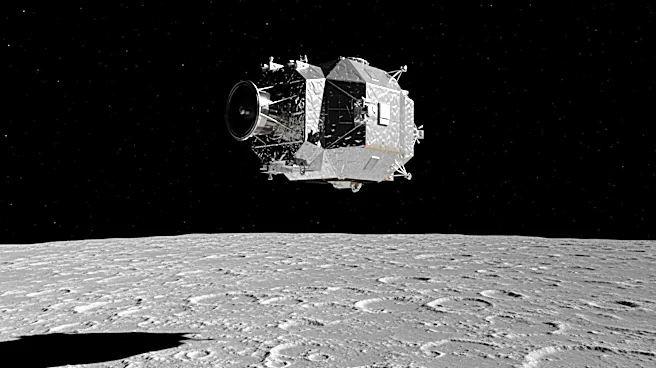









Lunar Orbiter 4 was a pivotal mission in the United States' efforts to explore the Moon. Launched on May 4, 1967, this spacecraft was tasked with photographing the lunar surface and collecting scientific data. Its mission was part of a broader program aimed at mapping the Moon to aid future lunar exploration, including the Apollo missions.
Mission Objectives
The primary goal of Lunar Orbiter 4 was to capture detailed images of the Moon's surface. Unlike its predecessors,
which focused on potential Apollo landing sites, Lunar Orbiter 4 had a broader scientific scope. It was designed to photograph the entire nearside of the Moon and a portion of the far side. This comprehensive imaging was crucial for understanding the Moon's geography and planning future missions.
In addition to its photographic objectives, Lunar Orbiter 4 was equipped with instruments to measure cosmic radiation and detect micrometeoroid impacts. These scientific experiments were essential for assessing the lunar environment and ensuring the safety of future crewed missions.
Achievements and Challenges
Lunar Orbiter 4 successfully entered an elliptical orbit around the Moon on May 8, 1967. Despite technical difficulties that cut the imaging mission short on May 26, the spacecraft transmitted over 500 useful photographs back to Earth. These images provided unprecedented views of the lunar surface, contributing significantly to lunar science.
The mission's other instruments performed well, gathering valuable data on cosmic radiation and micrometeoroid impacts. This information helped scientists understand the conditions that spacecraft and astronauts would face on the Moon, informing the design of future missions.
Impact on Future Lunar Exploration
The data collected by Lunar Orbiter 4 played a crucial role in the success of subsequent lunar missions. By mapping the Moon's surface in detail, the mission helped identify safe landing sites for the Apollo program. The images and scientific data also enhanced our understanding of the Moon's geology and environment.
Lunar Orbiter 4's achievements demonstrated the feasibility of remote lunar exploration and set the stage for more advanced missions. Its success underscored the importance of thorough scientific investigation in planning human exploration of the Moon.
In conclusion, Lunar Orbiter 4 was a landmark mission that advanced our knowledge of the Moon and laid the groundwork for future exploration. Its contributions to lunar science and exploration planning remain significant, highlighting the mission's enduring legacy.