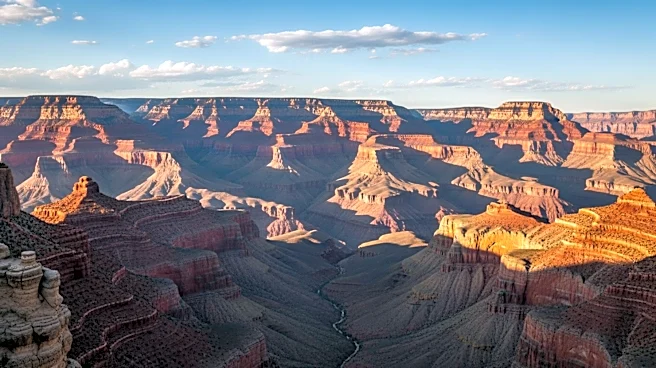




The Grand Canyon, located in Arizona, is one of the most iconic natural wonders in the United States. Known for its immense size and intricate landscape, the canyon offers a glimpse into nearly two billion years of Earth's geological history. Carved by the Colorado River, the Grand Canyon is a testament to the power of natural forces and the beauty of geological formations.
Formation and Structure
The Grand Canyon is a steep-sided canyon carved by the Colorado River. It stretches
277 miles long, up to 18 miles wide, and reaches depths of over a mile. The canyon exposes uplifted Proterozoic and Paleozoic strata, making it a significant geological site. The Colorado River established its course through the area about 5 to 6 million years ago, driving the down-cutting of tributaries and retreat of cliffs, which deepened and widened the canyon.
The canyon's formation is attributed to the uplift of the Colorado Plateau, which steepened the stream gradient of the Colorado River and its tributaries. This increased their speed and ability to cut through rock. The uplift, combined with weather conditions during the ice ages, increased water flow in the Colorado River drainage system, further deepening the canyon.
Geological History
The Grand Canyon's geological history is complex, involving multiple segments formed at different times. The "Hurricane" segment was formed 50-70 million years ago, while the "Eastern Grand Canyon" was cut 15-25 million years ago. The "Marble Canyon" and "Westernmost Grand Canyon" segments were carved in the last five to six million years.
The canyon's rock layers range from the two-billion-year-old Vishnu Schist at the bottom to the 270-million-year-old Kaibab Limestone on the rim. The Great Unconformity represents a gap between 1.75 billion and 1.25 billion years ago, where no deposits are present. The canyon's depth and strata height are due to 5,000-10,000 feet of uplift of the Colorado Plateau.
Hydrology and Erosion
Groundwater flow in the Grand Canyon region is influenced by geologic faults and folds. The canyon has two major aquifers where groundwater collects: the higher C-aquifer and the confined R-aquifer. Springs discharge to the Grand Canyon in areas of lower Paleozoic carbonates, associated with geologic faults and fractures.
The base level and course of the Colorado River changed 5.3 million years ago when the Gulf of California opened, lowering the river's base level and increasing erosion rates. Volcanic activity between 100,000 and 3 million years ago deposited ash and lava, obstructing the river at times. These volcanic rocks are the youngest in the canyon.