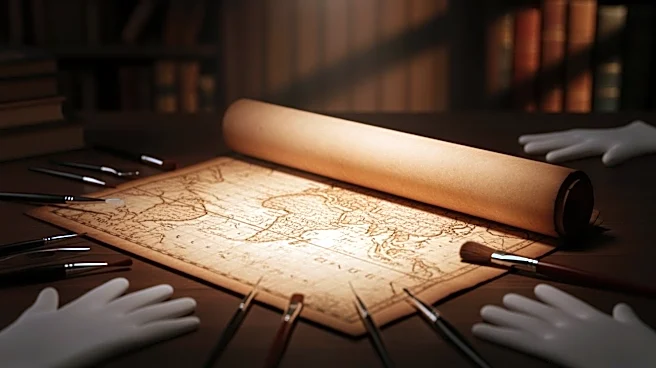






The Waldseemüller map, created in 1507, is a remarkable artifact in the history of cartography. Known for being the first map to name the Americas as "America," it was thought lost for centuries until its rediscovery in the early 20th century. The journey of this map from its creation to its preservation at the Library of Congress is a fascinating tale of historical intrigue and scholarly dedication.
The Creation and Initial Impact
The Waldseemüller map was created by Martin Waldseemüller and
his colleagues at the Vosgean Gymnasium in Saint-Dié-des-Vosges, Lorraine. It was part of a project to update geographical knowledge based on recent discoveries. The map was accompanied by the book "Cosmographiae Introductio," which explained the decision to name the new continent America after Amerigo Vespucci.
Printed in twelve sections, the map used a modified Ptolemaic projection to depict the Earth's surface, including the newly discovered lands in the western hemisphere. It was widely distributed and became influential among contemporary cartographers, solidifying Waldseemüller's place in history. However, over time, the map's whereabouts became unknown, and it was presumed lost.
Rediscovery in the 20th Century
The Waldseemüller map remained lost until 1901 when it was rediscovered by the Jesuit historian and cartographer Joseph Fischer. Fischer found the map in the library of Prince Johannes zu Waldburg-Wolfegg in Schloss Wolfegg, Württemberg, Germany. This discovery was a significant event in the history of cartography, as it brought to light a crucial document that had been missing for centuries.
The map was in remarkably good condition, considering its age, and it provided valuable insights into the early 16th-century understanding of the world. Its rediscovery sparked renewed interest in Waldseemüller's work and the history of cartography, leading to further research and study.
Preservation and Legacy
In 2001, the United States Library of Congress purchased the Waldseemüller map from the House of Waldburg for ten million dollars, making it the most expensive map ever sold at the time. The map is now housed in a specially designed microclimate case at the Library of Congress, where it is preserved for future generations.
The preservation of the Waldseemüller map ensures that this important piece of history remains accessible to scholars and the public. Its legacy continues to be celebrated for its role in shaping the European understanding of the world and its influence on subsequent generations of explorers and cartographers. The map's journey from creation to rediscovery and preservation is a testament to the enduring significance of historical artifacts and the importance of preserving them for future study.